
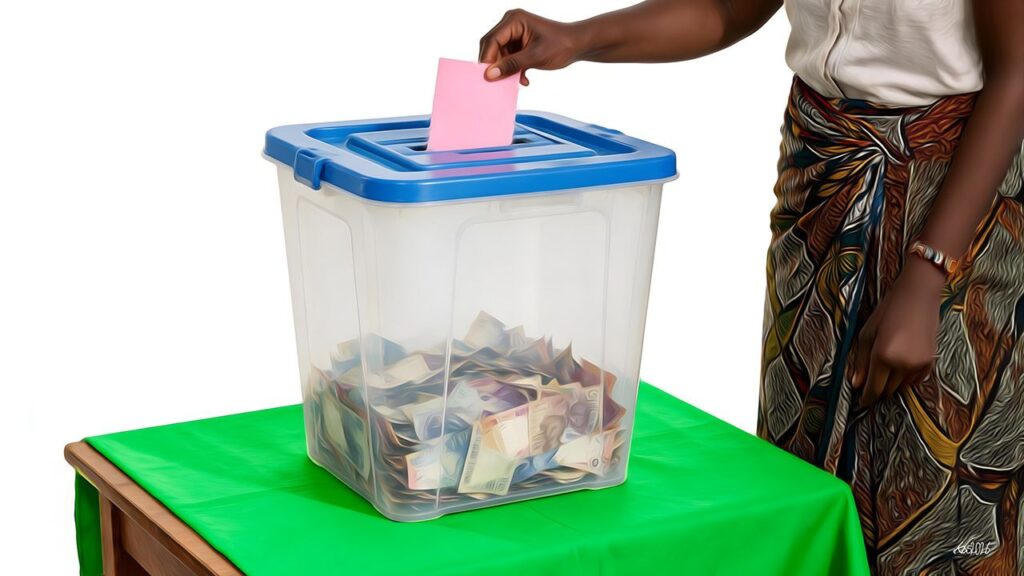
In mid-July, I participated in the Conference on the Financialization of Politics in Africa that was held in Accra, Ghana. The conference brought together various stakeholders from the continent, with representatives from the African Union, governments, civil society, and development partners. The conference was organized by the Community of Practice on Money in Politics with the support of the Centre for Democratic Development in Ghana (CDD-Ghana), the Open Society Foundations (OSF), and the African Union Advisory Board Against Corruption (AUABC). The aim of both the Community of Practice and the conference was to begin structuring meaningful engagement between stakeholders who are committed to deepening democracy and integrity in Africa by curtailing the growing influence of money in politics.
The conference succeeded in developing a strongly shared understanding of the nature and extent of the problem at hand with respect to the increasingly central role that finance is playing in African politics, both within and outside electoral seasons. During elections, it is widely understood that money plays an important role in determining who makes it to the ballot and, more often than not, how they fare in the election. A series of studies by the Westminster Foundation for Democracy (WFD) and their partners have shown how expensive it is for people to run for office in Africa. Their latest studies, conducted in 2020 and 2021, found that it costs an average of US$68,215 for a parliamentary seat in Ghana and US$182,000 in Kenya. These are high figures that end up excluding from political competition people with limited access to finance, especially women and youth. Hence, it is often noted that many of the young people and women who get into politics often rely on sponsors and godfathers. Of course, some are independently wealthy, which often raises speculation about the source of their wealth. These are important issues to engage with and address with respect to the exclusionary nature of expensive elections, not just for women and youth, but also for other marginalized groups.
Vote buying
One issue that seems to have occupied much of our attention is the question of vote buying. It is often believed that most of the money that is spent in politics goes towards voter bribery. As the argument goes, vote buying is a problem because it distorts political choices and is therefore a major threat to democracy. A lot of work and investment by democracy promoters have gone into this area, piquing the interest of my friend and colleague Dr Sae’ed Husaini. Writing based on an ethnographic, comparative study of four different locations in Nigeria, he argues that this focus may be misplaced. He finds that vote buying is neither as prevalent nor as effective as the focus we place on it suggests. That is, most people do not actually receive the money that is supposedly distributed by politicians and many of those who receive it believe that they are free to make their choices independent of these inducements.
There are many potential case studies to look at, but Kenya presents some interesting recent examples that offer great fodder for analysis. In the recent by-election in Ol Kalou, the ruling party invested heavily in inducements to voters and still lost embarrassingly. Even noting that by-elections are quite different from general elections, we can examine how the money was flowing to get a more refined sense of the extent of the distribution of funds and also explore why it was not effective in swaying the voter to support the incumbent government.
However, leaving voter suppression aside for now, we must also compare this with the preceding by-elections, such as in Mbeere North where, with heavy inducements during the campaign, the ruling party emerged victorious. Such an analysis would help us obtain a richer view that will further enhance our understanding of this phenomenon. Similar studies across other African countries may help to build a strong body of evidence that would challenge prevailing orthodoxy and perhaps allow for more room to engage on other questions on the impact of financialization on politics and policy.
Looking beyond elections
It is an issue of concern that the conversation on the financialization of politics often focuses on elections, with less attention being paid to how money is also a tool for purchasing policy outcomes in the period between elections. It is true that financiers invest in …