
On July 7,
Prime Minister Abiy Ahmed told Parliament
that Ethiopia had earned a record $3.1 billion from coffee exports. Six days later,
the National Bank of Ethiopia reported
that coffee export volume was down from the same period a year earlier.
Both statements can be true. That is the problem.
For a coffee-growing household in the coffee belt around Harar, in the East and West Hararghe zones of eastern Ethiopia’s Oromia region, the contradiction is not statistical. Coffee brings one concentrated seasonal income after months of work and exposure to world prices. Khat, a stimulant crop whose leaves are widely chewed in Ethiopia and neighbouring countries, can be harvested several times a year and sold into strong domestic and export markets. A national coffee record can therefore coincide with a family deciding that coffee no longer pays often enough, or reliably enough, to keep the land.
Ethiopia knows what coffee earned at the border. It does not regularly publish what growers in major coffee-producing areas such as Hararghe, Jimma, Sidama, Guji, or Yirgacheffe were paid, what it cost them to produce the crop, or whether anything remained afterward.
A record at the port is not a farm-gate account.
The blind spot extends beyond Ethiopia.
The U.N. Food and Agriculture Organization estimates
that up to 25 million farming households produce 80 percent of the world’s coffee. Producing countries measure exports and foreign exchange far more precisely than they measure whether those households can afford the next crop.
Higher international prices do not pass fully or evenly to producers. Inflation can absorb part of the increase before it reaches the farm. So can labour and transport costs, scarce financing, compliance expenses, and the bargaining power of everyone between the grower and the port. A rising export total matters to the national economy, but it tells us little about what remains with the producer.
Governments have built the port ledger. What they lack is the farm-gate ledger: a record of the price the farmers are actually paid where they first sell.
Ethiopia already has much of the administrative capacity needed to build one. Since 2020, the Ethiopian Coffee and Tea Authority and the central bank have operated a minimum export-price system. An export contract below the applicable minimum cannot be registered and therefore cannot ship. The schedules vary by origin and grade. A similar weekly minimum now applies to licensed domestic coffee sales made in foreign currency.
The machinery exists, but it has been used to protect export value rather than track producer income.
Ethiopia also created one of Africa’s most ambitious agricultural price-information systems through the Ethiopian Commodity Exchange, the country’s national agricultural trading platform.
A peer-reviewed study found
that bringing public exchange-price screens closer to rural households raised real income, with larger gains for coffee and sesame.
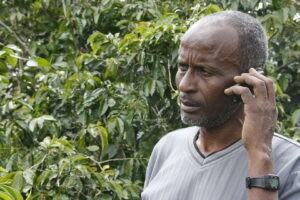
Coffee farmer Feleke Dukamo checks coffee-price information in Ethiopia.
But those screens showed what a lot fetched at the exchange after the coffee had left the farm. They did not show what growers in a district were paid that week or what it cost them to produce the crop. Farmers could see the market’s price, not their own.
The gap has widened as more coffee moves through direct transactions outside the exchange. More prices are set in private deals that no public screen records. Ethiopia has not lost a farm-gate ledger because it never built one.
As EU deforestation rules and other origin-verification requirements push buyers to trace coffee back to where it was grown, buyer-driven traceability is expanding. But traceability built for buyers is not the same as a public farm-gate ledger. The first gives the smallholder another obligation; the second gives the grower a reason to participate. A verified payment record can serve both purposes: documenting origin and supporting a claim when the regional price falls below a published benchmark.
The missing account matters especially because coffee is perennial. Governments can finance seedlings, nurseries, extension services, and processing equipment. They can ask growers to stump, or cut back, old trees so that they produce larger harvests later. But a rehabilitated tree produces little or nothing while it recovers, and the family still has to live through those seasons.
A household may first cut spending or …