
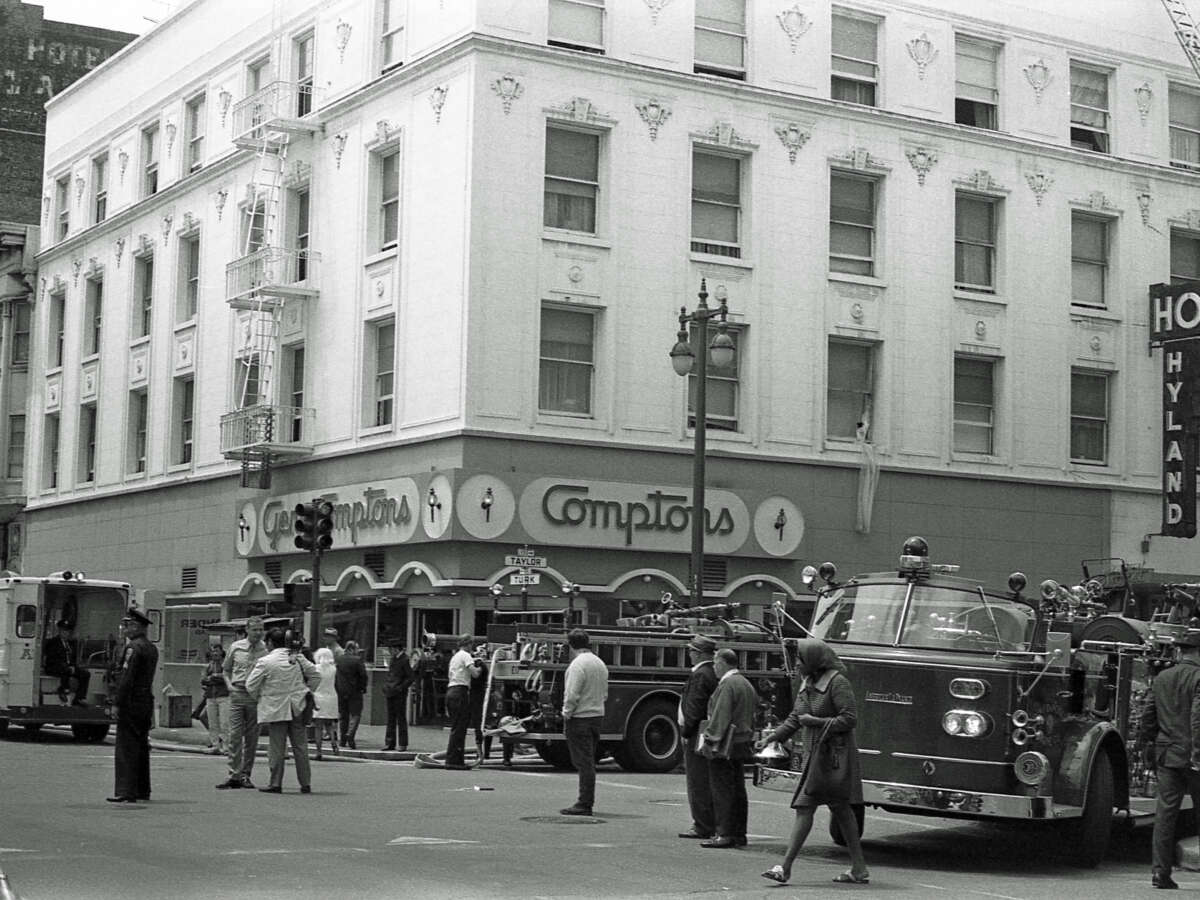
Organizers in San Francisco are fighting to reclaim Gene Compton’s Cafeteria from GEO Group.
Truthout is a vital news source and a living history of political struggle. If you think our work is valuable, support us with a donation of any size.
The first recorded instance of militant resistance to police harassment by queer people in the country turns 60 this month, but it isn’t widely known. Three years before the infamous Stonewall uprising, trans women and queer people responded directly to repeated bullying and targeting by police at Gene Compton’s Cafeteria in San Francisco’s Tenderloin neighborhood.
The Tenderloin has historically been a vital place for queer people, trans people, sex work, community, and organizing, according to leaders working in the neighborhood today.
“It’s been housing for people kind of living on the margins of society. And I think people on the margins of society are in a place to question the kind of status quo that’s rejected them,” said Katie Conry, executive director of the Tenderloin Museum, a cultural institution that produces a play commemorating the riot. “And I think that’s why you see a lot of early social justice movements have roots in organizing in the Tenderloin.”
In August 1966, queer people, trans people, and “queens” gathered at Gene Compton’s Cafeteria on the corner of Turk and Taylor Street, as they had so many nights before. At the time, trans people and queens could be arrested for charges including “female impersonation” and “obstructing the sidewalk.” When a police officer attempted to make an arrest, it was the final straw for those who had faced similar instances of harassment for decades. Instead of complying, a “street queen” launched a cup of coffee at the officer, beginning a violent and united display of resistance. Officers were hit with purses, sugar shakers — anything that queer and trans people in Compton’s could find. While the night at Compton’s ended with a burning newsstand, broken cop car windows, and lots of arrests, the resistance started the momentum necessary for an entire movement, according to historians.
(“Queens” or “street queens” were identifying terms used predominantly for feminine-presenting people who were assigned male at birth. While not all “queens” or “street queens” engaged in sex work, it was a common hustle in the Tenderloin at the time. The term “queen” has evolved to be most commonly associated with drag artists; however, not every reference to “queens” or “street queens” in the 1960s was to identify someone in drag.)
“Compton’s is extraordinarily relevant because at the heart of what that story is about is also what the contemporary story of trans people is about,” said Isaac Fellman, director of archives and special collections at the GLBT Historical Society. “I think like all of the other fights that trans people have had to take up, it comes down to: Are you going to acknowledge my dignity and therefore give me all of the other things that as a human being with dignity, I need and have a right to?”
Compton’s uprising predates Stonewall, and so many other notable milestones in LGBTQIA+ history, but it has received significantly less recognition. There remains no agreed-upon date for the riot. Until a historian found isolated news headlines referencing it, the uprising was basically buried.
“The reason I think why there has been so little contemporary documentation of the riot is that night, the cops got their asses handed to them on a plate,” said Dr. Susan Stryker, the historian who brought Compton’s into mainstream historical coverage.
After initially discovering sparse coverage of Compton’s from the 1960s, Stryker dug deeper. In recognizing the critical gaps in where the movement began, Stryker worked with partners to create a documentary of the riot, titled Screaming Queens: The Riot at Compton’s Cafeteria, which was released in 2016.
“The basic motivation for what happened that night was people just hit a limit, and they erupted,” said Stryker. “It is radical, direct, basic, and militant. Any treatment of the riot, historically or artistically, that does not capture how basic the act of resistance was and how powerful it was, is selling the story short. That kind of militancy of the resistance often gets lost in representations or discussions of Compton’s.”
Stryker’s record of the events inspired further celebration and acknowledgement of Compton’s, both in San Francisco and for the LGBTQIA+ community more …