
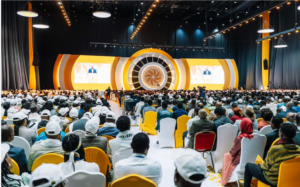
As Ethiopia’s National Dialogue seeks to chart a path toward peace, it faces an immense task. The Dialogue aims to address some of the country’s most difficult political, historical, institutional, social, and peacebuilding questions. Yet its success may ultimately depend on confronting a more basic question: why do Ethiopia’s major conflicts keep returning?
Ethiopia’s National Dialogue Conference, Addis Ababa, 15 July 2026
A problem relocated, not resolved
One answer lies in a problem that has received too little attention. The challenge of nation-building was not resolved after 1991; it was relocated. As political authority came to be organised through ethnoregional states, regional governments became central arenas for managing recognition, representation, and self-government.
This is not an argument against recognition or self-government. Recognition and autonomy expanded opportunities for political participation, representation, and self-rule. But they also changed the way political competition worked. Regional governments became more than administrative units. Through language policy, education, administration, media, public narratives, and territorial claims, regional institutions have often created hierarchies of belonging rather than equal citizenship, making some citizens appear more native, legitimate, or entitled than others. Ethiopia’s recurring conflicts are therefore not only about power. They are also about a system that made identity, territory, representation, and authority increasingly hard to separate.
As these institutions matured, political competition increasingly centred on the representation and defence of communities defined by territory and identity. Contests over leadership, resources, or administration have become securitized struggles over status, belonging, and political survival. While institutions do not cause violence by themselves, they can encourage political actors to present territorial control as a matter of group survival. Losing political power is often experienced not simply as an electoral setback, but as a threat to a group’s place in the political order.
Wolkait, and what it really reveals
This becomes clearest where territory intersects with competing claims of belonging and authority. The Wolkait conflict illustrates the point. Although often presented as a conflict over administrative boundaries, it also reflects deeper questions about membership, government, and the political meaning of territory. Historical claims, constitutional arrangements, ethno-linguistic boundaries, land grievances, displacement, and Ethiopia’s post-1991 regional order all matter. But they do not fully explain why Wolkait became so politically consequential.
The conflict is also about political belonging: who is treated as native, who is seen as a recent settler, and whose authority is considered legitimate. For many Tigrayans, Wolkait’s incorporation into Tigray became part of regional self-government. For many Amharas, it symbolised exclusion from land they regard as historically theirs. It is therefore not only about maps or legal status. It is also about land, memory, identity, representation, and authority.
Wolkait is not an isolated case. Similar patterns appear elsewhere, even when the histories and grievances differ. Addis Ababa offers another example. Its layered history and diverse population show how difficult it is to fit lived belonging into a single ethnic-territorial frame. The continuing conflicts involving the Oromo Liberation Army, an armed Oromo insurgent group, and Fano, a loosely organised Amhara militia movement, illustrate how struggles over security, recognition, and authority become tied to claims about belonging.
Persistent insecurity, displacement crises, and identity-targeted violence across Ethiopia point to a deeper problem. When authority is tied closely to identity and land, basic questions of residence and administration become politically explosive. Politics becomes less about policy or public services, and more about membership, recognition, and control over political space. The human-rights costs can be severe for many citizens, but they are especially acute for people seen as outsiders in the places they live.
This deeper tension is not new. For much of the post-1991 period, the Ethiopian People’s Revolutionary Democratic Front, or EPRDF, contained it through elite bargaining, central control, and a powerful security apparatus. But containment was …