
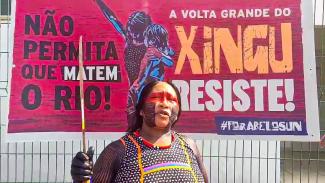
The Price of Gold: The Xingu River and the Communities Facing Destruction
Country
Brazil
agnes
Tue, 07/28/2026 - 10:50
Issues
Human Rights
Program
5
Main Image
By Angel Ferreira
(Payayá, CS Intern)
At Volta Grande do Xingu, Brazil, two Indigenous communities, the Arara da Volta Grande and the Yudjá, continue to defend their ancestral territories against mounting external pressures. For the Yudjá, their name carries profound significance: it affirms their sovereignty and enduring relationship with the Xingu River, a bond that shapes their identity, culture, and way of life.
Today, however, their traditional livelihoods face a severe threat. The Volta Grande Project, backed by an estimated $229 million investment from Belo Sun Mineração Ltda., a subsidiary of Belo Sun Mining Corp., aims to establish one of the largest open-pit gold mines in the region. Community leaders and environmental experts warn that the project could inflict irreversible damage on a river system already deeply destabilized by the Belo Monte Hydroelectric Dam.
To understand the technical, social, and legal dimensions of this ongoing struggle, Cultural Survival spoke with anthropologist Thais Mantovanelli from the Instituto Socioambiental (ISA) / Xingu Program.
Thais Mantovanelli.
CS: With your experience of over a decade following the Juruna-Yudjá and Xikrin Peoples as well as the riverside communities, how are the mere expectations and pressure of Belo Sun's arrival already altering the social dynamics and mental health of these communities?
Thais Mantovanelli:
The Volta Grande do Xingu region, composed of three Indigenous territories and hundreds of riverine families where Belo Sun intends to establish itself, currently faces the risk of reaching a point of no return, both environmentally and in terms of the social conditions required for the physical and cultural reproduction of these Peoples. This is because the chain of impacts from the operation system of the Belo Monte Hydroelectric Power Plant has weakened the region's ecological and social system far more aggressively than anticipated in the project's environmental impact studies. This terrifying scenario is well known to these collectives, whose current and ancestral traditional knowledge reinforces this catastrophic assessment.
Given this backdrop, the prospect of a mining project aiming to become the largest open-pit gold mine in the country severely impacts their social dynamics and mental health. It is an attack on the future of coming generations and on the maintenance of a cultural system intrinsically linked to the flood pulse of the Xingu River and its tributaries.
A climate of dread now governs the daily lives of these families, who are forced to mentally cope with the risk of human contamination associated with the mining project. The venture could cause shocks and instability in Belo Monte’s structures, such as the Pimental dam and other dikes, as well as the risk of a tailings dam failure, similar to what occurred in Brumadinho and Mariana. Other threats include the scaring off and poisoning of land animals on the islands; impacts on birds due to noise pollution from explosives (projected to operate 24/7 for at least 12 years); the death of fish species already scarce due to Belo Monte’s operating system; navigation risks; airborne pollutant dispersion; pressure on the territory caused by an influx of workers; and risks of sexual violence against girls and women in the territory due to the increase in unknown men arriving to join the mining project's workforce.
The threat of Belo Sun's installation represents a massive strain on the mental health of these collectives, who lose control over the management of their lives in both the present and the future.
CS: Volta Grande do Xingu is already experiencing ecocide caused by Belo Monte's "consensus hydrogram." From an anthropological and subsistence perspective, what would the overlay of a mega gold-mining project mean for these Peoples in this context of water scarcity?
TM:
The current operating system of Belo Monte, through the consensus hydrogram, diverts 80% of the Xingu River's flood pulse during the flooding, high-water, and receding phases of the hydrological cycle, including the dry season. Indigenous and riverine Peoples of Volta Grande say that a river's flood pulse is like a person's heartbeat. They urge us to imagine what our own living conditions would be like if we …