
How Dignity and Resistance of the Maya Tz’utujil Peoples Triumphed over Corruption
Country
Guatemala
diana
Wed, 07/29/2026 - 11:44
Issues
Human Rights
Program
5
Main Image
By Kerstin Sabene
On July 2, 2026, I boarded a
lancha
, a small public boat from Panajachel to the Maya Tz'utujil village of Santiago on Lake Atitlan in Guatemala, which has been the site of heightened tensions since the beginning of the year.
On October 24, 2025, the people of Santiago Atitlan succeeded in removing Mayor Francisco Coché Pablo from office on corruption charges. They forced his ouster following accusations of corruption regarding the illegal authorization of motor taxi licenses and a failure to respond to demands from ancestral authorities. They also succeeded in having the Supreme Electoral Tribunal recognize First Councilman Andrés Ajuchán Coó as the new mayor.
In February 2026, the Supreme Court ruled in Coché's favor, and he was technically reinstated with a provisional authorization to return to his post. Guatemala’s judicial system is highly corrupt, and the court’s ruling by no means implies that the charges against Coché were invalid or that he was exonerated. The Tz’utujil Peoples rejected the Supreme Court's ruling in favor of Coché and fiercely protested his reinstatement.
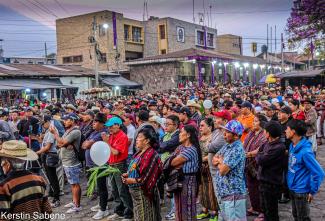
Peaceful protesters in Santiago's central park.
As I made my way up to town from the dock in Santiago, I was shocked by the broken glass, large chunks of concrete, rocks, and other debris strewn along the passageway. A few men who had gathered here explained they didn't want to clean it up because it was evidence, and the municipality's employees hadn’t yet arrived to take photos.
Walkway from Santiago dock up to town strewn with rocks, glass, and debris on July 2, 2026.
Members of the community who had been demanding Coché’s resignation learned that he was at a meeting on July 1 inside the ChukMuk Eco museum on the outskirts of town. People were protesting peacefully outside the museum until, at some point, someone attempted to set fire to the museum. Chaos ensued, and gunfire erupted; Coché was rushed to a boat by police, where he was transported to Panajachel and then to a nearby hospital for his injuries. The rocks strewn near the dock most likely had been used to pelt the vehicle Coché was evacuated in that morning.
As a result of the chaos, a man lost his life. Family, friends, and community members gathered on July 4 to bid a final farewell to Pedro Ixabalán Reanda (Maya Tz'utujil), 44, who died from a gunshot wound. According to witnesses, Ixabalán was participating in the protest demanding the resignation of Coché. Several other people were also injured.
People in Santiago's central park signing a petition on February 15, 2026.
I proceeded to the park during my brief visit on that Thursday morning, where things were calm and appeared normal. The colorful market with its multitude of vendors and cornucopia of fruits and vegetables was in full swing. Local residents, mostly women, were discussing what had just transpired. One woman told me they were expressing their sorrow about the death of their community member and all of the injuries that had occurred. Another young woman said she was concerned about what they would do if the military were sent in, even though the army is prohibited from entering the municipality of Santiago.
To understand how the people of Santiago succeeded in expelling the army from their town in 1990 is to understand the survival, pride, and peaceful resistance of the Maya Tzutujil culture. It began during Guatemala’s 36-year internal conflict between the state and leftist guerrillas following the Panabaj Massacre on December 2, 1990. During the civil war, a military outpost was established in the Panabaj district of Santiago Atitlán municipality, ostensibly in response to the growth of the guerrilla movement. Late on December 1, 1990, a group of people who were tired of a decade of military intimidation marched toward the site carrying white flags, having agreed not to throw projectiles or provoke the soldiers. Leading the procession were the outgoing mayor and the mayor-elect, Salvador Ramírez y Ramírez, who was due to take office in a few days.
Upon their arrival, before Ramírez y Ramírez could speak to a superior officer, gunfire erupted, instantly killing 11 people, including children. Two more people died later in medical facilities, while more than 20 …