
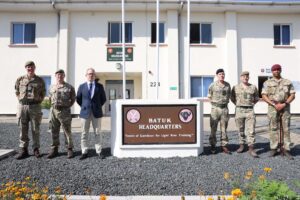
In July 2026, Britain suspended one of its flagship military exercises in Kenya after Nairobi withheld the licences required for troops to train in Laikipia. Five days later, the two governments reached an agreement allowing Exercise Haraka Storm to proceed. The immediate diplomatic crisis ended, but the deeper dispute did not; the standoff revealed that Kenya is no longer questioning the terms of Britain’s military presence but using licensing, parliamentary oversight, and domestic law to press for new legal terms governing how that presence operates.
The strategy has been in development for several years, and it owes much to the unresolved murder of Agnes Wanjiru. When a Kenyan court issued an arrest warrant for a former British soldier in September 2025, and he was subsequently arrested in the UK that November as he contested extradition, it crystallised a constitutional principle: that Kenyan courts have jurisdiction over crimes committed on Kenyan soil, regardless of the suspect’s nationality.
That assertion now sits at the centre of live negotiations for the renewal of the Defence Cooperation Agreement governing the British Army Training Unit in Kenya (BATUK), which remains under active parliamentary negotiation and is not yet finalised. In 2021, Kenya’s Parliament made a previous attempt to strip BATUK personnel of diplomatic immunity, which the UK rejected. The renewed negotiations now take place against a backdrop of years of litigation, parliamentary scrutiny, and renewed public scrutiny, and, as July demonstrated, a Kenyan government prepared to act on that pressure.
BATUK and the Accumulation of Grievances
The Wanjiru case is the most visible, but it is not the only one. Over decades, BATUK’s presence in Laikipia and Nanyuki has generated a series of disputes that have exposed gaps in the oversight mechanisms surrounding the agreement.
In August 2025, the UK government finalised an out-of-court settlement of £2.9 million for more than 7,700 claimants affected by the 2021 Lolldaiga Hills wildfire, which was linked to British military training exercises. Individual payouts ranged from around KES 22,500 to KES 2.5 million depending on the claim—sums many residents said bore little relation to years of lost livestock, health complications, and land damage. The UK did not admit liability. “The settlement was never just about compensation,” Charles Lawi, a community leader in Laikipia, told me. “It was about getting someone to admit responsibility.” For many advocates, the settlement’s existence proved that accountability was achievable, but its terms illustrated why ad hoc arrangements are an inadequate substitute for institutionalised legal responsibility.
Other grievances remain unresolved. Communities near training areas have documented long-running complaints about unexploded ordnance in farmland; parliament has repeatedly raised concerns about environmental damage from vehicle movements, live-fire exercises, and inadequate land rehabilitation; and Kenyan women have also sought legal recognition and child support for children allegedly fathered by British soldiers, exposing how little formal infrastructure exists to handle such claims.
Taken individually, each dispute can be managed, delayed, or minimised. Taken together, they describe a partnership that has operated with limited legal exposure—and a Kenyan public that is increasingly unwilling to accept that arrangement.
What the Negotiations Are Actually About
Neither Nairobi nor London has signalled an intention to terminate the defence partnership. Instead, the 2026 review has become an opportunity for Parliament, lawmakers, and affected communities to demand stronger legal safeguards. Civil society campaigns no longer confine the pressure. It is now evident in a parliamentary report that recommends fundamental changes to the legal framework governing BATUK.
In late 2025, the National Assembly’s Committee on Defence, Intelligence, and Foreign Relations published the findings of a two-year inquiry. The report documented allegations of sexual abuse, environmental harm, and negligence involving unexploded ordnance. It also criticised BATUK officers for declining to appear before the committee by citing diplomatic immunity, recommending that immunity be removed for serious crimes and that mechanisms be created to establish paternity and enforce child maintenance. The British High Commission later said its submission to the inquiry had not been …