
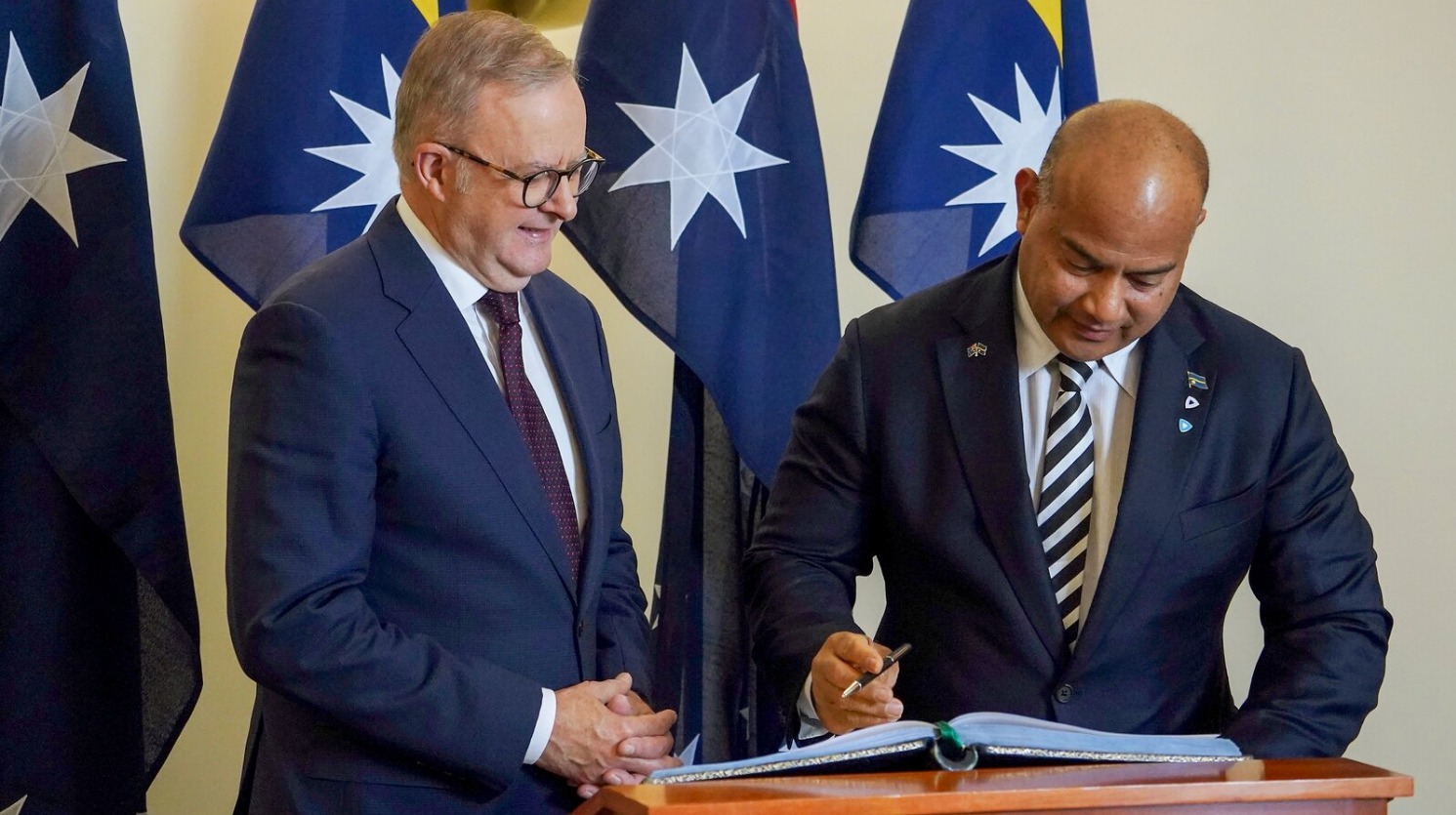
Amidst great diplomatic pomp, Australia signed two new treaties with Fiji in July, known as the Ocean of Peace Alliance and the Vuvale Union. Together, they commit the two countries to jointly meet any security threat faced by either party, and announce their hostility to any unnamed “third parties” establishing a military presence in the Pacific. This makes Fiji just the fourth country with which Australia has concluded a formal military alliance, along with the United States, New Zealand and Papua New Guinea.
The Fiji treaties represent the latest victory for Australia in a diplomatic offensive going back several years. Since 2024, Australia has also concluded security agreements of varying form with Tuvalu, Naoero (Nauru), Vanuatu and PNG. Negotiations with the Solomons Islands over a new security treaty are ongoing.
Reading through the treaties, you will find many rhetorical flourishes about mutual respect and shared values. But the single most important word for understanding Australia’s diplomatic agenda does not appear at all. That word is “China”. These new treaties are aimed squarely at maintaining Australia’s dominant position as a neo-colonial power in the south-west Pacific, blocking China from establishing its own security relationships with Pacific island nations.
Australia: neocolonial power in the south-west Pacific
The treaties run on a spectrum of deference towards Australia, depending on the relative strength or weakness of the Pacific state concerned. At one extreme, the Fiji treaties commit the two countries to mutual defence, with no further concessions to Australian interests. Fiji has largely avoided the financial problems afflicting many Pacific states and has an established military of its own.
At the other end of the spectrum are smaller countries that are financially dependent on Australia, and for which the terms of the security treaties are far from equal. Notably, Australia now has veto power over Naoero or Tuvalu establishing a security partnership with any other country. What’s more, Australia now also has the right to block third parties becoming involved in so-called critical infrastructure in the island nations. These are assets that are primarily civil in nature rather than military, but which have security applications, including ports, aviation, telecommunications, banking and energy—in short, the basis for any sort of modern economic activity. Although maintaining their formal independence, these countries are one step away from becoming Australian protectorates. Vanuatu’s position is slightly stronger, and it has to consult Australia only on third-party involvement in critical infrastructure.
It remains to be seen what terms Australia can extract from the Solomon Islands. Former Prime Minister Manasseh Sogavare at times tried to play China and Australia off against each other to extract concessions. In 2022, he signed a deal with China to provide training and equipment for local police, precisely the kind of involvement Australia wants to preclude. But China’s involvement in the country has been contentious in domestic Solomon Islands politics, and current Prime Minister Mathew Wale is more inclined to look to Australia for support.
From Australia’s perspective, though, the most important security relationship in the Pacific is with PNG. The lessons of World War Two, when Japan advanced across the island of New Guinea before being halted, have deeply ingrained themselves within Australian military thinking. To the generals and strategic analysts, PNG represents a kind of defensive rampart for the Australian mainland. Anything other than a strong Australian grasp on this territory is therefore unthinkable.
The Mutual Defence Treaty signed in 2025 formalises this thinking. It declares that an armed attack on either party is considered a collective security threat and entrenches already close defence ties between the countries. This includes intelligence sharing, aligning logistics and defence industries, and developing shared bases, such as at the Lombrum naval base at Manus Island, which is currently being expanded at a cost of half a billion dollars. The established practice of embedding Australian personnel within the PNG military will continue.
In addition, the treaty now provides for the recruitment of PNG citizens directly into the Australian armed forces. This offers Australia a way to boost the size of its military, which for decades has lagged behind …