
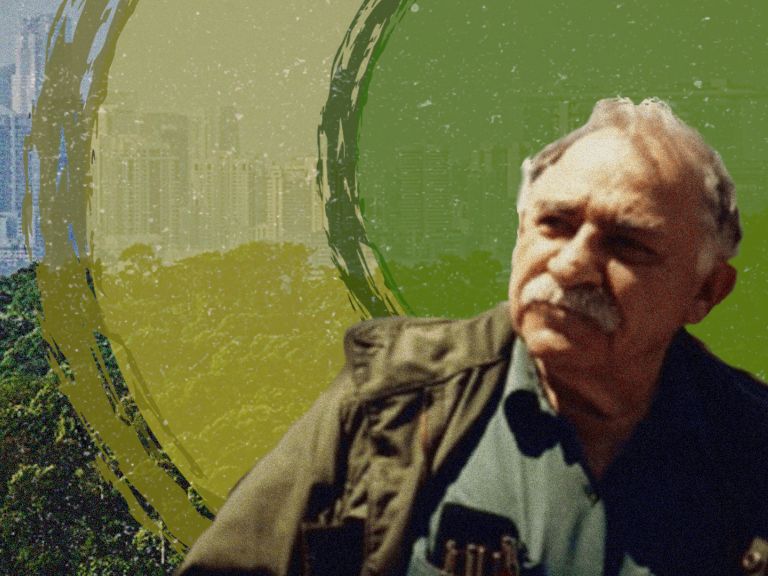
Murray Bookchin was a person that devoted his life to the development of Social Ecology and Communalism as theoretical tools of a comprehensive social project for the challenges that both humanity and nature face. Through tireless teaching, speaking, organising, and writing, Bookchin presented a humanist vision of ecology based on community, direct democracy, and the better promises of the Enlightenment, showing how we could transform our society into one that is free and egalitarian.
Bookchin was not interested in creating a new political dogma or metaphysical ideology, which to elevate him to an “armchair” intellectual status, while providing his audience with post-modern fancy word-salads. No, he was not interested in this and was not afraid to engage in fierce political debates with other thinkers and political tendencies. Bookchin did not hesitate to criticise the postmodernist nihilist politics of renowned philosophers of past and present like Nietzsche, Heidegger, Foucault, Derrida, Lyotard, Deleuze, and Baudrillard. He was also highly critical of political movements like anarcho-syndicalism and Marxism . Bookchin recognised their historic importance, but couldn’t overlook their role today—an attempt to fall back, in times of a terribly fragmented reality, onto obsolete, even archaic ideologies in a search for a sense of continuity and security. And of course, he never hid his complete disagreement with New Age and mysticism-centred streams that tend to delude and depoliticise social movements until today.
Bookchin’s late abandonment of the anarchist label can be viewed not as a renouncement of his radical libertarian ideals, but as a symbolic act aimed at showing how little meaning there is in ideological dogmas and ideological purity. What he was most interested in was the power of vibrant and developing ideas. A classic ideology that remains entrapped in the spatiality and temporality of its birth was an obstacle to Bookchin to inspect ongoing developments in society and search for coherent alternative paths. In this sense what really interested him the most was the question of genuine revolutionary social change and all of his work should be viewed as a call to action.
Bookchin refused to remain entrapped in old ideological interpretations of the world, which is evident from his secular interest in ecology. Traditional leftist fascination with factories could not distract him from the environmental degradation provoked by industrial capitalism. Long before climate change took over the news and the human influence on it became widely accepted, Bookchin began warning humanity for the disastrous environmental impact its activities had. But unlike various mysticists and primitivists who blamed human nature as such, he noted that it was the way human societies are being structured that determines humanity’s attitude towards nature and began researching alternative forms of social organisation that could pave the way towards an ecological and democratic society. His work produced a theoretical body that he termed Social Ecology, which nowadays is gaining momentum among climate activists and beyond.
Bookchin drew a direct link between social organisation and human interaction with nature. The way societies treated their natural environment was a reflection of the way their interrelations were structured and thus suggested that statecraft and capitalism led to the creation of a reckless and wasteful anthropological type. He then explored linkages between direct democratic forms of societal organisation that could result in stewardship and a symbiotic relation with nature.
Bookchin recognized the importance of science, which often led him to clash with deep ecologists and primitivists. But while recognising the liberatory potential of technology, he was in no way a techno-fetishist. For Bookchin, the technological development in a capitalist setting was shaped by the latter’s values and driven to serve its purposes. Thus, technologies that could potentially be made to put an end to scarcity were instead used for profits and production of artificial shortages. He knew that the road to a post-scarcity society would have to be based on a libertarian political transformation, rather than on quick techno-fixes.
Bookchin’s insistence on the importance of management of political power made him quite the distinctive thinker. He could see that it was not simply a question of implementing a new economic model or …