
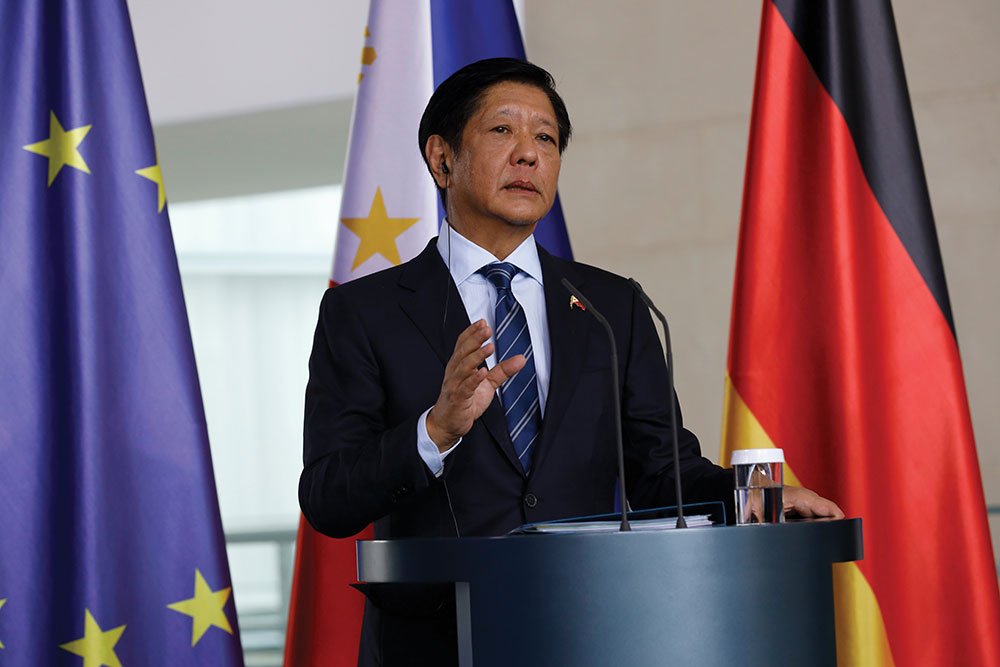
Ferdinand “Bongbong” Marcos Jr. Credit: Juergen Nowak / Shutterstock.com Beyond Geopolitics: The Philippines in the New Marcos Era Edited by Cleo Anne A. Calimbahim and Björn Dressel ISEAS – Yusof Ishak Institute: 2026 . When I need to explain the collapse of the ‘UniTeam’ alliance between President Ferdinand “Bongbong” Marcos Jr and his vice-president, Sara Duterte, I like to use a—ahem—highly sophisticated political paradigm of ‘Team Kadiliman (Darkness) versus Team Kasamaan (Evil)’. The reference is to a video of a hapless Harry Roque, the former Rodrigo Duterte spokesperson and current fugitive, rallying his former boss’s supporters outside Congress. In the clip, he says, in Filipino, that the battle is no longer between the Dutertes and the Marcoses. Instead, he goes, “it’s a fight between the forces of darkness versus the forces of…?” He pauses expectantly.
“Evil!” the crowd shouts innocently.
“The forces of good!” he corrects them.
To my delight, Carmel V. Abao references the same viral video in her chapter, ‘The Marcos Jr. Administration: From Populism to Reformism?’, in , edited by Cleo Anne A. Calimbahin and Björn Dressel. Abao recounts the twists and turns of Marcos Jr’s presidency until the midterms in 2025, helping readers navigate the workings of these fractious elite coalitions.To read the rest of this article, and to access all Mekong Review content, please subscribe. If you are an existing subscriber, please login to your account to continue reading.
Being a Singapore government think tank, the tends to publish on relatively timely issues, quickly. For example, they published Games, Changes and Fears: The Philippines from Duterte to Marcos Jr.—on the transition from Duterte to Marcos Jr—in 2024, just two years after the presidential election. Drawing on the expertise of mainly academics, Beyond Geopolitics serves a middle audience sandwiched between the needs of political operators, who need analysis fresh out of the news cycle, and historians, who are utterly unhurried and probably wouldn’t mind waiting a few decades for proper perspective. Taken together, the book helps make sense of developments in the past years and months across different fields, helpful for watchers of Philippine politics to fill gaps in their knowledge of major issues. It’s a hefty eighteen-chapter collection, so there’s practically something for everyone.
Jan Carlo Punongbayan tells us about the economy at midterm: plummeting growth, weak consumption, inflationary pressure on food and energy, slow investment. He’d written a book dispelling economic myths about the administration of Ferdinand Marcos Sr—the ousted dictator and father of the current president—so he also shows us signs of “Marcosian” rehabilitation like Kadiwa stores, Masagana rice self-sufficiency, and, crucially, the Maharlika Investment Fund, evoking programmes and ideas from the dictatorship. His chapter ties in with others that do deep dives into subjects like agriculture and infrastructure. There’s a chapter on development challenges in the Bangsamoro Autonomous Region in Muslim Mindanao (BARMM) written by Acram Latiph, a good reference on the region as it goes into a long-awaited election this September. Weena Gera, meanwhile, writes an illuminating chapter on the Mandanas-Garcia ruling of the Supreme Court that expanded the base for local governments’ share of revenues to include all national taxes. She argues that decentralisation, including Marcos’s current inclinations, fails to follow the maxim “finance follows function” and risks further dysfunction in providing local services. Many of these chapters offer policy recommendations that are evidence-based and well reasoned.
I enjoyed the cluster of chapters around the notion of Philippine politics being oligarchic in nature. What better way to enjoy the national soap opera than tales of cutthroat sibling rivalry? Athena Charanne Presto’s chapter on Marcos and his sister, Senator Imee Marcos, lays out the differences in their temperaments, talents, and strategies. Not enough is written about the Marcoses in their father’s bailiwick of Ilocos Norte, and this is where her work is quite revelatory. For example, the absenteeism and party boy image of Marcos Jr as president was already evident in abundance when he was the provincial governor. Snide remarks about the son not having the political acumen of the father were already being made about Junior when he was in local politics. As their father …