
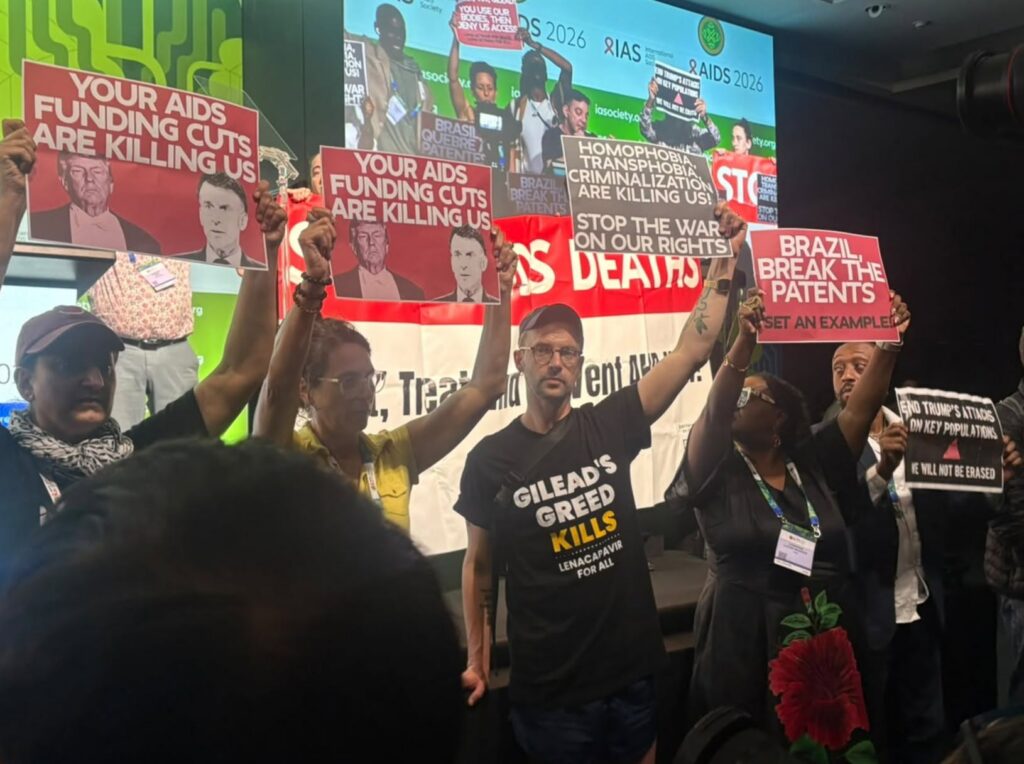
On Monday, I was among the protesters who stormed the opening ceremony of the 26th International AIDS Conference in Rio de Janeiro, Brasil, the largest scientific conference on HIV in the world. I was there alongside comrades from organisations including ACT UP, HealthGap, Médecins Sans Frontières, HIV i-base, and the Health Justice Initiative. We took the microphones, raising our voices against the greed of pharmaceutical companies, and the complicity of governments who have slashed their humanitarian aid, severely affecting efforts to combat diseases such as HIV.
Our protests had begun before the official opening. After gathering at 7 AM, we interrupted a presentation by Jeff Graham, acting US Global AIDS Coordinator and the man responsible for the President’s Emergency Plan for AIDS Relief (PEPFAR), which the Trump administration gutted in early 2025. We raised placards reading “Stop the Blackmail. Stop the Lies. Release PEPFAR Funds. Follow the Science” and “Trump’s Cuts Kill People with AIDS. Restore PEPFAR Now”. We chanted “You lie, we die,” while South African campaigners added a single word: “Murderer.”
As Asia Russell, Executive Director of Health GAP, explained: “The U.S. government has stolen HIV treatment from 77,163 HIV positive children, slashed PrEP enrollment by 42 percent, closed 1,700 PEPFAR HIV treatment sites, decimated programs led by and for key populations, implementers report slashing condom programming by 93 percent”.
I spoke afterwards with my friend Dr. Tristan Barber, Chair of the British HIV Association (BHIVA), who also witnessed the protest. “The US is telling other countries to step up their HIV response and says America wants to get the best value from every dollar spent on international aid. It’s clever political spin because, while most people agree the global HIV response shouldn’t depend on a single country, the speed of these cuts has been devastating.
Removing references to minoritised groups like MSM (men who have sex with men) and trans people means funding no longer reaches many of those at greatest risk. To make matters worse, we’ve been told the US is actively pursuing partnerships with faith-based organisations that are themselves perpetuating discrimination. We have to remember this narrative is coming from the richest and most powerful country in the world, which has just spent $37 billion on a war that wasn’t even supported by Congress.”
The US nevertheless continues to market itself as a benevolent philanthropist, without an ounce of reflection of how centuries of entrenched colonialism and unequal power continue to shape healthcare. “The U.S. government must be held accountable for the ongoing, global public health emergency they are causing,” said Anele Yawa of South Africa’s Treatment Action Campaign. “No matter what the U.S. says in conference halls, we must believe the people served by PEPFAR, believe the data, and demand the U.S. reverse course.”
UNAIDS lost about 25 per cent of its total financial aid last year, said the organisation chief Winnie Byanyima. “There is a need for Africa to quickly adapt its systems for health in order to keep its people alive and to work towards health sovereignty. We don’t have time to lose. This is a moment of radical change”.
Protests also took place at the French stall at the conference. France reduced its contribution to the Global Fund to Fight AIDS, Tuberculosis and Malaria by 58% for the 2026–2028 cycle, cutting its pledge from EUR 1.6 billion to EUR 660 million. “If donors don’t fund HIV they can start digging graves”, said Kenyan activists. In Sub-Saharan Africa, there has been increasing criminalisation of people with the virus since the “Great Unfunding”, which has resulted in the closure of clinics and a spike in suffering and death.
Then there’s the pharmaceutical industry. From the airport to the conference entrance, the shiny propaganda of big drug companies like Gilead, Merck and VIIV is unavoidable. It would be easy to think they were friends of people like me living with HIV. That illusion quickly crumbles when you learn that Latin America is experiencing a new form of colonialism, while governments such as Brazil are seeking a ‘secrecy price’ for life-saving medication that should be available for all.
“It’s like a bomb that will explode in a few years,” Latinx activists on the ground warned. The pharmaceuticals industry is one of the most lucrative in the world, generating significantly more profit …