
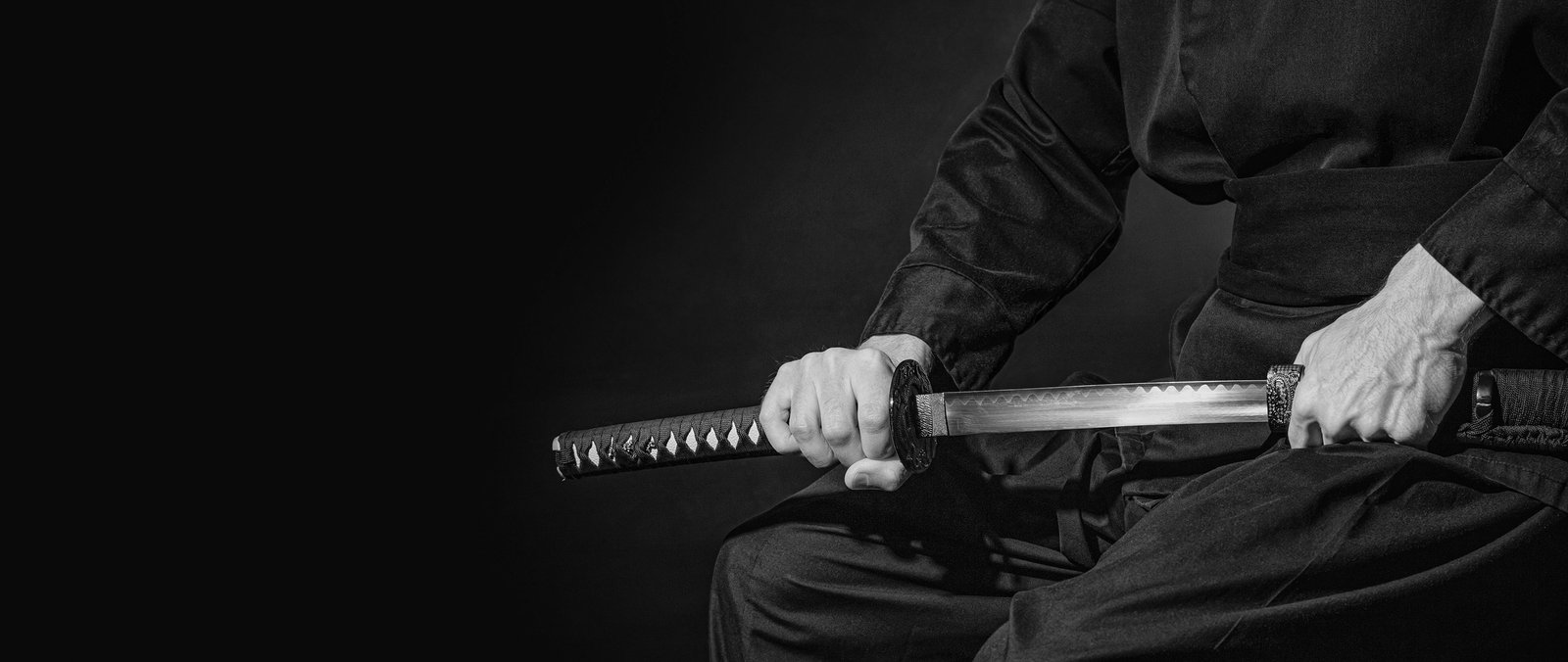
A samurai with a katana . Credit: Nymphalyda Musashi: The Novel (Books One to Three) Eiji Yoshikawa, translated by Alexander Bennett Tuttle Publishing: 2026 . On a frigid January morning, I boarded a train from the samurai castle town of Himeji and journeyed west into the mountainous hinterland of Okayama Prefecture. Changing to a one-carriage diesel locomotive at the small town of Sayo, I continued on through long tunnels and deep valleys until, at a lonely siding, the train stopped. The sole passenger, I disembarked at the village of Miyamoto.
“Miyamoto Village lay silent,” writes Eiji Yoshikawa in the early pages of Musashi: The Novel, his sprawling samurai epic about the wandering swordsman, Miyamoto Musashi, whose search for life’s meaning takes him through the deep valleys, castle towns, and snow-bounded hinterlands of western Japan. Miyamoto Village did indeed lie silent as I trudged towards it—its traditional homesteads all but submerged in fresh snow, wooden shrines and temples groaning under the weight of the drifts.
Readers needn’t travel so far for a taste of rural Japanese antiquity. While Yoshikawa, who completed Musashi in 1939, has done those hard yards and spared you the trouble, it is Alexander Bennett, an Antipodean martial artist and scholar, whose translation of the original manuscript in its entirety now gives international readers access to the atmosphere and thrills of Japan’s greatest samurai tale.
This new unabridged version is no light undertaking. Told over three volumes, it comes in at a hefty 1,696 pages. But there are plenty of reasons to make the commitment. For one, it is a rollicking yarn with a cast of colourful characters. The settings are ever-changing; from rural hamlets, snowy mountain passes, and bamboo forests, to hectic city streets with brothels, boozy taverns, temples, and dojos, the reader is whisked along at a lively clip. This is feudal Japan in the early Edo Period—about 400 years ago—a time when the country was transitioning from civil war to an era of peace, order, and artistic freedom. Alongside martial arts, Yoshikawa also gives us cultural practices such as tea ceremonies, calligraphy, and flower arrangement—arts which samurai of yore engaged in to strengthen their mental discipline and build character.
Miyamoto Musashi was a real person who lived from 1594 to 1645. His name is known to all Japanese—if not as ‘Kensei (sword saint)’, then as a folk hero whose legendary strength and skill are still revered. Kids emulate his Niten Ichi-ryū (Two Heavens as One) style of swordsmanship with Chanbara foam swords; brands of kitchen knives, health supplements, home security systems, and even automotive parts are named after him. My local hardware store is called “Musashi”.
Yoshikawa has been instrumental in all of this, of course, popularising historical fiction with his reimagining of the lives of famous samurai figures in works like Taiko and The Heike Story—inspiring countless movies, TV dramas, and manga. Bennett’s new translation of Musashi—more than four decades after Charles S. Terry’s version—is sure to extend that popularity to an international readership.
Bennett is aptly qualified. A resident of Kyoto who lectures on Japanese history and culture at a university in Osaka, he holds multiple black belts in kendo, iaido, and naginata, among others. He is also editor-in-chief of Kendo World, an English-language publication on Japanese martial arts. So, when he states in his introduction that Musashi is “more than just a tale; it’s a meaningful interpretation of Japan’s cultural and philosophical heritage”, I’m inclined to believe him.
Musashi’s plot is epic but not unwieldy, charting the legendary swordsman’s physical and spiritual journey across the three volumes, each named after Godai (五大), the five great elements of Japanese Buddhist philosophy which represent the universe.
Musashi: Book One – Earth, Water and Fire begins on the corpse-strewn plains of Sekigahara, the site of Japan’s most decisive battles between the Eastern and Western warring states. We are introduced to the teenage ruffian, Takezō, and his hapless childhood friend, Matahachi, who, seeking adventure and glory, have sadly ended up on the losing side.
The two friends escape. Returning to Miyamoto Village, Takezō meets Takuan, a monk who forces him to take a long hard look at himself:
“You have natural brawn and a dash of boldness, but you’re woefully lacking in brains. You’ve mastered …