
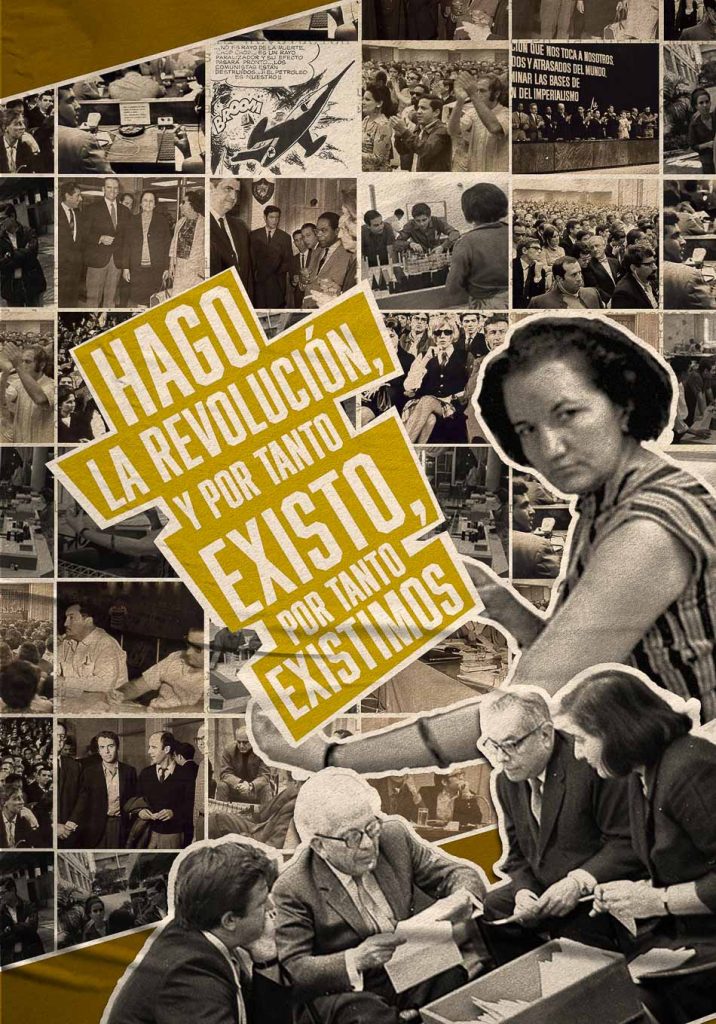
The collages in this dossier were created by Tricontinental: Institute for Social Research based on images and speeches from the 1968 Cultural Congress of Havana, courtesy of Cubarte.
‘There can be nothing more anti-Marxist than dogma… nothing more anti-Marxist than the petrification of ideas’.
– Fidel Castro, closing speech, Cultural Congress of Havana, 12 January 1968
1
‘I make revolution, therefore I exist, therefore we exist’.
– René Depestre, commission I, Cultural Congress of Havana, 1968
2
On the morning of 4 January 1968, in the Hotel Habana Libre, Cuban president Osvaldo Dorticós opened the Cultural Congress of Havana. Over the following 9 days, 470 delegates from 70 countries would fill the commission rooms. Together, they sought to understand how imperialism operates through culture in all its dimensions and what it would mean to build an anti-imperialist front capable of confronting and dismantling it.
3
The congress took place at a moment when revolution felt not only possible but imminent. Vietnam was fighting the most powerful military on Earth to a standstill. Armed liberation movements in the Portuguese colonies of Angola, Guinea-Bissau, and Mozambique were building new societies in the zones they had already liberated.
4
Across Latin America, guerrilla movements were multiplying in the wake of the Cuban Revolution. The peoples of the Third World were in motion on every front. The grief over Ernesto ‘Che’ Guevara’s murder in Bolivia three months earlier had only sharpened the collective resolve of the delegates and the movements they represented. The question was no longer whether imperialism could be defeated but by whom and on what fronts.
The Cultural Congress of Havana was organised across five commissions that mapped the fronts on which the cultural battle was being waged: Culture and National Independence (commission I); the Integral Formation of Man (commission II); the Responsibility of the Intellectual (commission III); Culture and Mass Media (commission IV); and Artistic Creation and Scientific-Technical Work (commission V).
5
As Dorticós observed in his opening statement, it was ‘the first time, as far as we know, [that people] from all continents, belonging to different professions’ had been brought together around a common cultural mandate.
6
The decision to invite not only cultural workers such as artists and writers but also doctors, economists, sociologists, scientists, technicians, and intellectual workers of all backgrounds was a deliberate political choice, insisting that culture was not merely an auxiliary to political and military struggle but a front of anti-imperialist struggle in its own right.
The congress was not confined to commission rooms and speeches: it reverberated across the city through billboards, posters, and radio broadcasts. In the lead-up to the congress, the Instituto del Libro (Institute of the Book) published popular editions of works by several participating writers, and films by some of the delegates were screened in cinemas across Havana. On the evening of 9 January, the exhibition
Del Tercer Mundo
(From the Third World) opened at the Pabellón Cuba in Vedado. Conceived as a cinematic journey rather than a conventional exhibition, it used light, sound, montage, and movement to guide visitors through the unfinished history of Asia, Africa, and Latin America. Visitors moved through six zones that told the unfinished story of the Third World, from the myth of ‘virgin’ lands, through the violence and deprivation of imperial domination, and to the revolutionary struggles of the present. The exhibition drew on neon animations, comic strips, satirical film montage, and sound effects that included a horror tunnel of hunger and rotating light boxes that multiplied Cuban photographer Alberto Korda’s iconic image of Che alongside the question: ‘And we, the exploited of the world, what is our role?’ The exhibition, produced collectively by over a hundred people, was visited by more than 250,000 during its three-month run, with hours that allowed students and workers to attend on their way home, as if visiting a popular cinema.
7
The mass participation and cultural breadth of the congress embodied its foundational argument: that culture contains the totality of how a society produces and reproduces human life. As the congress’s general declaration concluded: ‘if the defeat of imperialism is the unavoidable prerequisite for the …