
In the period that followed decolonisation, Africa’s development landscape continued to be shaped by Western partnerships. By the late 1990s and early 2000s, this Western-facing architecture took the form of policy conditionality, governance agendas and institutional reform attached to rotating credit agreements. This approach rested, at least in part, on a simple reality: countries in the Global South had limited alternatives for accessing large-scale development financing.
At the beginning of the twenty-first century, most foreign aid and investment flowing into Africa still came from Europe and North America. Explicit conditionality had become a defining feature of development cooperation, making this ‘support’ increasingly complicated for many African governments. Much of it was anchored in a Western-determined narrative of what African states ought to look like, how their economies should function and how their institutions should be governed.
Today, while the language and form of conditionality have evolved, the underlying architecture has not changed quite as much. The Bretton Woods institutions have moved away from some of the more explicit conditionality associated with the structural adjustment era. Yet financing remains tied to policy commitments, including what the IMF now calls ‘structural benchmarks’ that borrowing countries are expected to meet.
Niger provides a recent example. Following the 2023 coup, the European Union, World Bank and United States suspended assistance, with the restoration of constitutional governance a key condition for renewed engagement. Niger’s military government, however, remained in place. Conspicuously, this did not deter Chinese engagement. Amid funding suspensions and sanctions, China’s CNPC provided a $400 million advance against future oil deliveries without attaching conditions on domestic governance. This has increasingly distinguished Chinese partnerships with African governments: financing and investment largely without explicit conditions on how countries govern themselves.
Similar conditionality had followed in Mali in 2021 and Burkina Faso in 2022. In Ethiopia, following disagreement over the government’s response to the Tigray conflict, the United States removed the country from the African Growth and Opportunity Act (AGOA), citing human rights concerns. The decision reinforced the principle that its development partnerships were anchored in respect for human rights. More recently, however, U.S. support for Israel during the Gaza conflict, where Palestinian rights have been perceived by many to have been significantly affected and where tens of thousands have been killed, has raised questions about the consistency with which these principles are applied.
As Western countries have continued to hold the line on conditions attached to financing, China has found space to broaden its partnerships across Africa. In 2023, Uganda passed its Anti-Homosexuality Act, prompting the World Bank to suspend new financing. President Yoweri Museveni’s government subsequently turned to China, including for a proposed $150 million loan to advance Uganda’s digital infrastructure. Notably, in 2025, the World Bank resumed financing without the legislation having been repealed. China’s role should not be overstated, but the episode points to a changing reality: where governments have alternative sources of financing, Western conditionality may no longer carry quite the leverage it once did.
The China–Africa partnership itself is not new. Its origins can be traced to the Bandung Conference of 1955, but a significant turning point came in 2000 with the establishment of the Forum on China–Africa Cooperation (FOCAC). FOCAC provided a platform for engagement on peace and security, political dialogue, trade and development cooperation. Africa already had established relationships with the OECD, World Bank, European Union and IMF. Through FOCAC, China institutionalised its own framework for engagement with the continent.
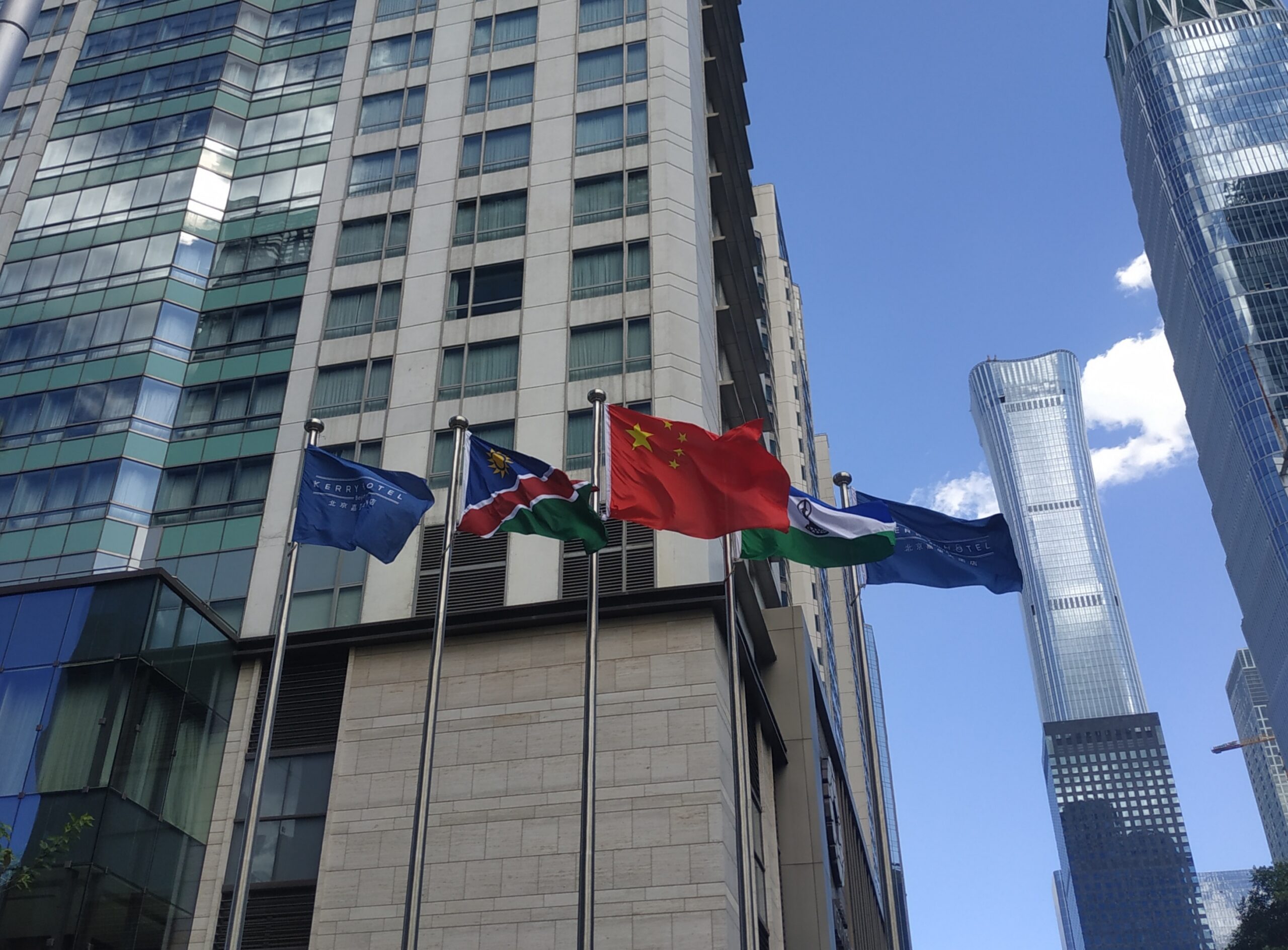
2018 FOCAC Summit in Beijing
The 2000s also marked a significant period in China’s geopolitical rise. Its economy expanded rapidly, reinforced by accession to the World Trade Organization, as Africa’s demand for infrastructure, investment and development finance grew. China had both the financial capacity and institutional mechanism to emerge as a formidable development partner.
China also approached Africa differently, framing the relationship more as one …