
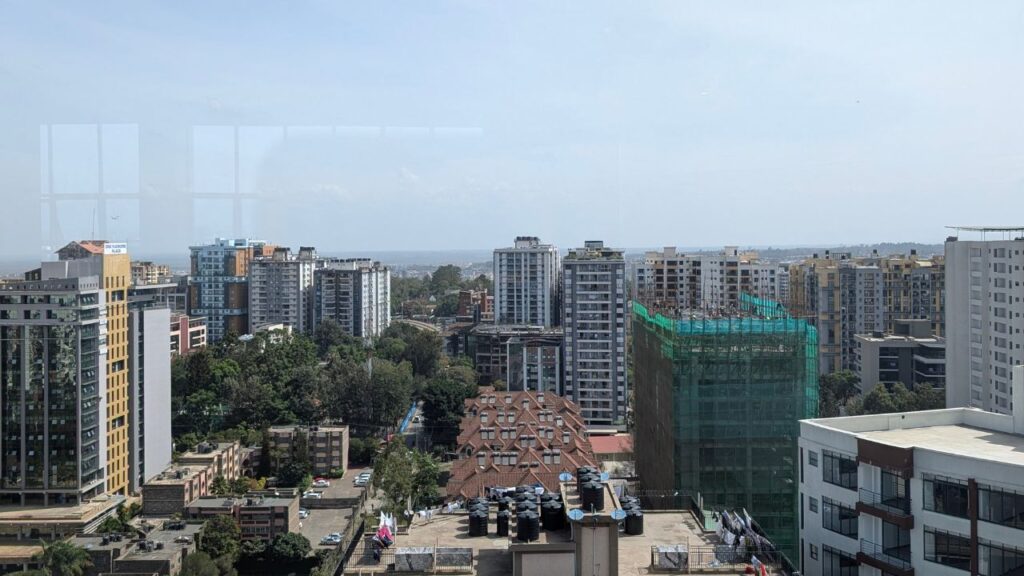
In recent years, Nairobi has become one vast construction site, and residents of Kenya’s capital appear destined to endure the relentless noise of building works for years to come. Across the city, the green scaffold netting draped over new developments has become an unmistakable feature of the urban landscape, signalling a skyline in constant transformation. What was once a controlled and relatively quiet living environment has been replaced by the incessant roar of excavators demolishing older buildings, drilling through bedrock, and excavating ever-deeper foundations to accommodate the city’s expanding high-rise apartments. The soundtrack of urban renewal has become an unavoidable part of daily life, raising broader questions about the costs of Nairobi’s rapid vertical growth.
The city’s apartment boom has also come to dominate
Nairobi’s advertising landscape
. A drive along Waiyaki Way, James Gichuru Road, Oloitoktok Road, or Ring Road in Westlands increasingly feels like a flipping through a real estate catalogue. Large-format billboards along these roads advertise luxury apartments, ranging from newly completed units to units under construction, some still in the pre-sale phase. On several of these major roads, advertisements for apartment developments appear to account for more than half of the large-format billboards, reflecting both the scale of the construction boom and the fierce competition among developers to attract buyers.
Some of Nairobi’s most established neighbourhoods, including South B, South C, Nairobi West, Kilimani, Kileleshwa, Parklands, Westlands, and the fringes of Lavington, have undergone particularly dramatic transformation since the early 2010s. What began as a gradual wave of redevelopment has
accelerated sharply in the 2020s
, with low-rise homes and modest apartment blocks increasingly giving way to clusters of high-rise residential developments. The pace of change has been so rapid that many of these neighbourhoods are now almost unrecognizable from what they were little more than a decade ago.
Supporters of Nairobi’s high-rise boom, including real estate developers and the city’s governor, Johnson Sakaja, argue that increasing residential density is essential to accommodate the capital’s rapidly growing population. They contend that expanding the city’s housing supply is necessary to meet both current demand and the needs of future residents.
Critics, however, argue that this vision has not been matched by comparable investment in the public infrastructure needed to support it. While the county government has championed higher-density development, opponents contend that roads, sewerage systems, water supply, drainage, and other essential services have not been upgraded at the same pace. The result is a city where vertical growth has outstripped the capacity of the infrastructure beneath it, placing increasing strain on both public services and the quality of urban life. And whenever it rains for more than three hours in Nairobi, the flooding that ensues is a stark reminder of this strain on public infrastructure.
For many residents, the issue is therefore not whether Nairobi should accommodate a growing population, but whether the city is expanding in a way that is planned, balanced, and supported by the infrastructure required to make high-density living sustainable.
Legislated dysfunction
Resident associations in
Kileleshwa
,
Kilimani
,
Lavington
, and
Westlands
have repeatedly challenged the approval of high-rise apartment developments in their neighbourhoods. For years, they argued that many of these projects contravened Nairobi’s zoning regulations, which historically restricted building heights in several of these areas to between four and six floors. In their view, the rapid proliferation of high-rise developments reflected a pattern of planning decisions that departed from the city’s own development guidelines.
These concerns gained renewed attention in June 2026 when the Ethics and Anti-Corruption Commission (EACC) announced the
recovery of more than Sh65 million in cash from Nairobi County’s Chief Officer for Urban Development and Planning
, alleging that the money constituted proceeds of corruption. The case remains under investigation, and no findings have yet established a link between the recovered funds and the approval of specific developments. Nevertheless, the incident has reinforced long-standing public concerns about the integrity …