
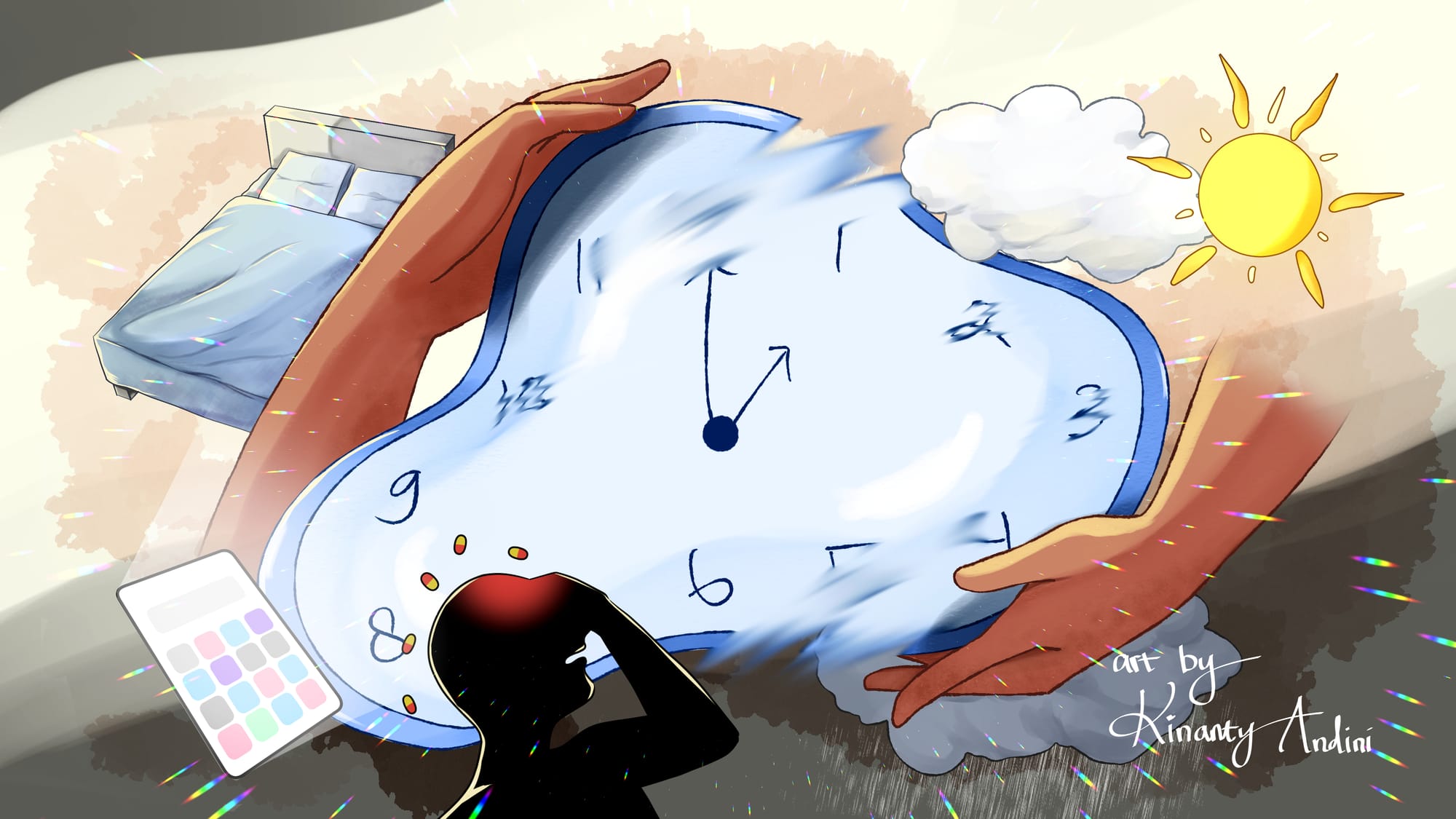
A new kind of clock, by Kinanty Andini
Dear Debriefers,
What time is it? Our disabilities change the question and its answer.
This edition looks at crip time, and some of the other stand-out pieces I've come across in my recent reading.
It covers extra time in exams, parenting disabled children, what hearing aids really do, and the concept of “accessibility hindering”.
Our open call for writing is about to close:
Dear Disability Diary
, which asks for up to 500 words on how disability shaped your day, is taking submissions until 20th July.
About this edition
Disability Debrief is published through a
pay-what-you-can
model.
Thanks to Ina, Jackie, Laura and Wang for new contributions.
Peter Torres Fremlin
is editor of Disability Debrief and is from the UK.
Kinanty Andini
is an illustrator and digital artist from Indonesia.
Sign-up to see the world through a disability lens
Subscribe
Email sent! Check your inbox to complete your signup.
Weekly in your inbox
A new kind of clock
“Crip time” refers to the ways that experiences of disability change our experiences of time, and expectations around it. In the UK, creative artist Jamie Hale writes about how it gives us a “
new kind of clock
”.
As Jamie writes, crip time doesn't just shift the perception of days or weeks, “but also the life course that stirs the whole body”:
“Disability routinely disrupts and forecloses the normative development timeline. We experience our education interrupted, our careers fragmented, and our relationships strained by the unpredictability of our bodies and minds. The questions of milestones, such as marriage and children, also become complicated or closed. Those milestones arrive late, in the wrong order, or are replaced by others entirely.
“We can have a complicated relationship to ageing - perhaps having been seen as having an early wisdom that comes from the life management skills acquired through illness, or perhaps ageing faster physically or psychologically than we could have been expected to. For some of us, we may also live with the knowledge that our timelines could be genuinely shorter than those around us.
Crip time isn’t just about the movement through an individual day, but also about the ways a life accrues meaning outside the standard shapes that life is given to us.”
This is just one of a series of pieces that I've been loving from
Jamie's substack
, which I strongly recommend. Back-to-back brilliant pieces include:
On Anger
: “Until the moment where your narrative arc ends in triumph, you are that bitter, disabled person”.
On Rest
: “There is a tension between what our bodies need now and what we feel we need to have done before we can’t.”