
In the Public Eye
GPEnewsdocs, with Lynn Fries:
In the 1st segment of an interview series on ecology and materialism conducted by journalist Lynn Fries, John Bellamy Foster explains how Marx, who was not a natural scientist learned from chemists, physicists, biologists and the ancient Greek philosopher Epicurus. Marx then garnered a unique theoretical approach that identifies the causes of the societal and ecological crises we face today. In Part 2, Foster debunks the misconception that socialism and materialism had no role in the development of ecological analysis. His research shows that socialist transformation involves the transformation of human relations with nature, and that the modern ecological movement grew out of Marx’s analysis of the dialectics of society and nature. And there again, the Epicurean strand carries right through. In the 3rd segment, Foster concludes that across different societies starting from ancient China, the Hellenistic world and India, there is a parallelism of class struggles. They involve notions of self-consciousness through production in relation with nature, human freedom, solidarity and substantive equality. Common to them is a praxis that combines Epicurus’s philosophy of enough and reciprocity with Marx’s emphasis on production and transformation. Says Foster in Part 1: “….Epicurus for Marx was a plus because he was very critical of religion or teleology – the notion that the gods or God determined things on earth. He rejected that without rejecting religion completely. And he emphasized that the basis of human life was community, friendship; building a society based on friendship. He was the first to bring women into philosophy – allowing them to emerge as major philosophers within the Epicurean school – and also slaves. He couldn’t do anything about slavery itself, but he brought slaves into Epicurean philosophy. They were given a high status. The whole society was organized around a garden. And emphasized sustainable living, and very ecological in orientation. Epicurus criticized those who thought that, “enough was too little”. The idea is that everyone needs enough but no one needs more than that….” Read more here and watch here.
Emancipations with Daniel Tutt
In late May, Helena Sheehan, Katarina Kolozova, Thomas Nail joined John Bellamy Foster in discussing his latest book, Breaking the Bonds of Fate: Epicurus and Marx, in a symposium hosted by Daniel Tutt. We encourage you to support Emancipations with Daniel Tutt, a series of public discussions on seminal works in the history of Marxist thought and philosophy. Watch below….
SPEAKERS:
Helena Sheehan is an Irish philosopher, historian of science, philosophy, culture and politics. Sheehan is professor emeritus at Dublin City University, where she taught media studies and history of ideas in the School of Communications.
Katerina Kolozova is a Macedonian academic, author and philosopher. She is the co-director and faculty at the School of Materialist Research, an international inter-university platform founded by Arizona State University. And she is the co-editor of Defending Materialism: The Uneasy History of the Atom in Science and Philosophy with Bloomsbury, released in 2025. She has written extensively about the non-philosophy of François Laruelle and the works of Karl Marx and has been a member of the Organisation Non-Philosophique Internationale (International Organization of Non-Philosophy),with headquarters in Paris, France.
Thomas Nail is a Distinguished Scholar and Professor of Philosophy at the University of Denver and author of numerous books, including The Figure of the Migrant, Theory of the Border, Marx in Motion, Theory of the Image, Theory of the Object, Theory of the Earth, Lucretius I, II, III, Returning to Revolution, and Being and Motion. His research focuses on the philosophy of movement.
The Critical Theory Workshop
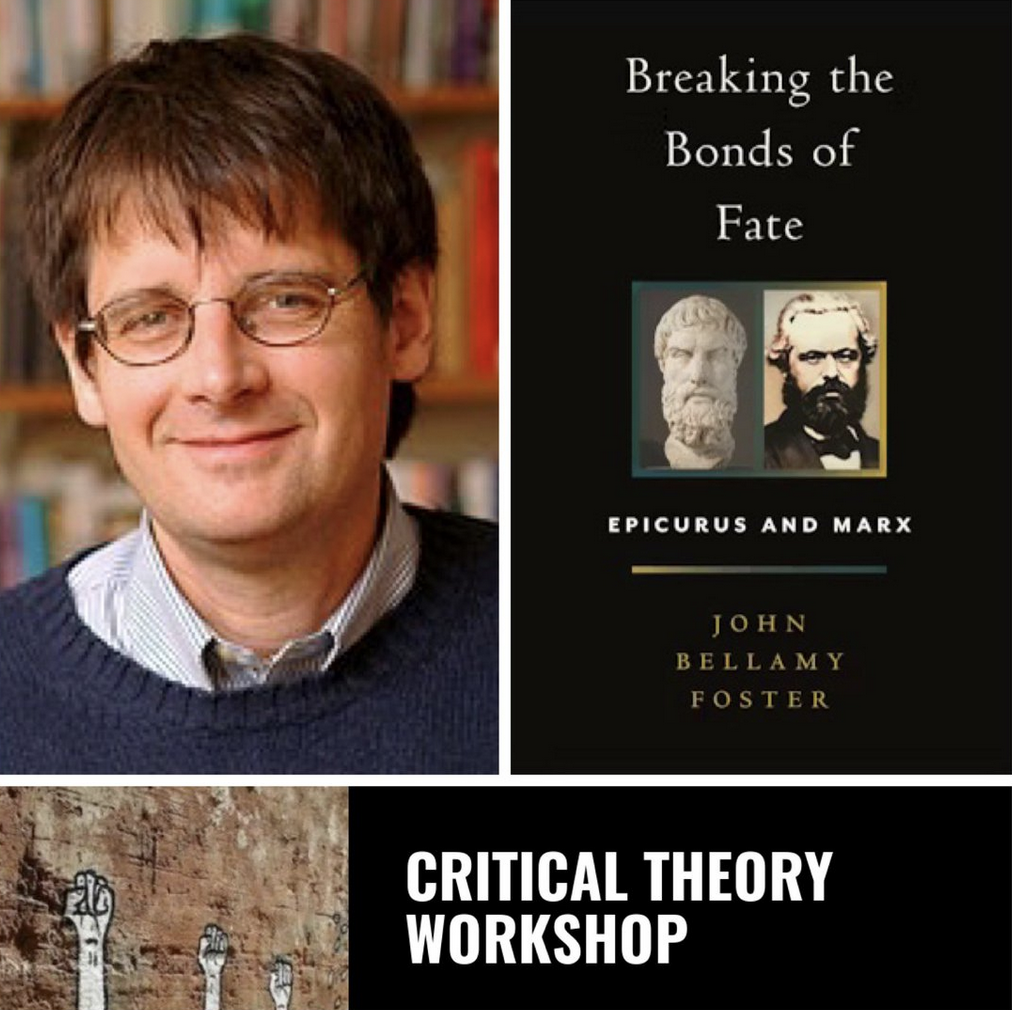
The Critical Theory Workshop was first to launch John Bellamy Foster’s excellent new work. Speakers alongside Foster included Boris Hennig and Paul Schafer, with Jennifer Ponce de León of The Critical Theory Workshop serving as the moderator: https://www.youtube.com/live/1PrDLsHiKkk
Theory and Struggle, by Richard Clarke
Foster’s latest blockbuster Breaking the Bonds of Fate though the most recent, fits logically as the first of the trilogy. It dismantles another myth: that Marx’s own doctoral thesis ‘The Difference Between the Democritean and Epicurean Philosophy of Nature’5 …