
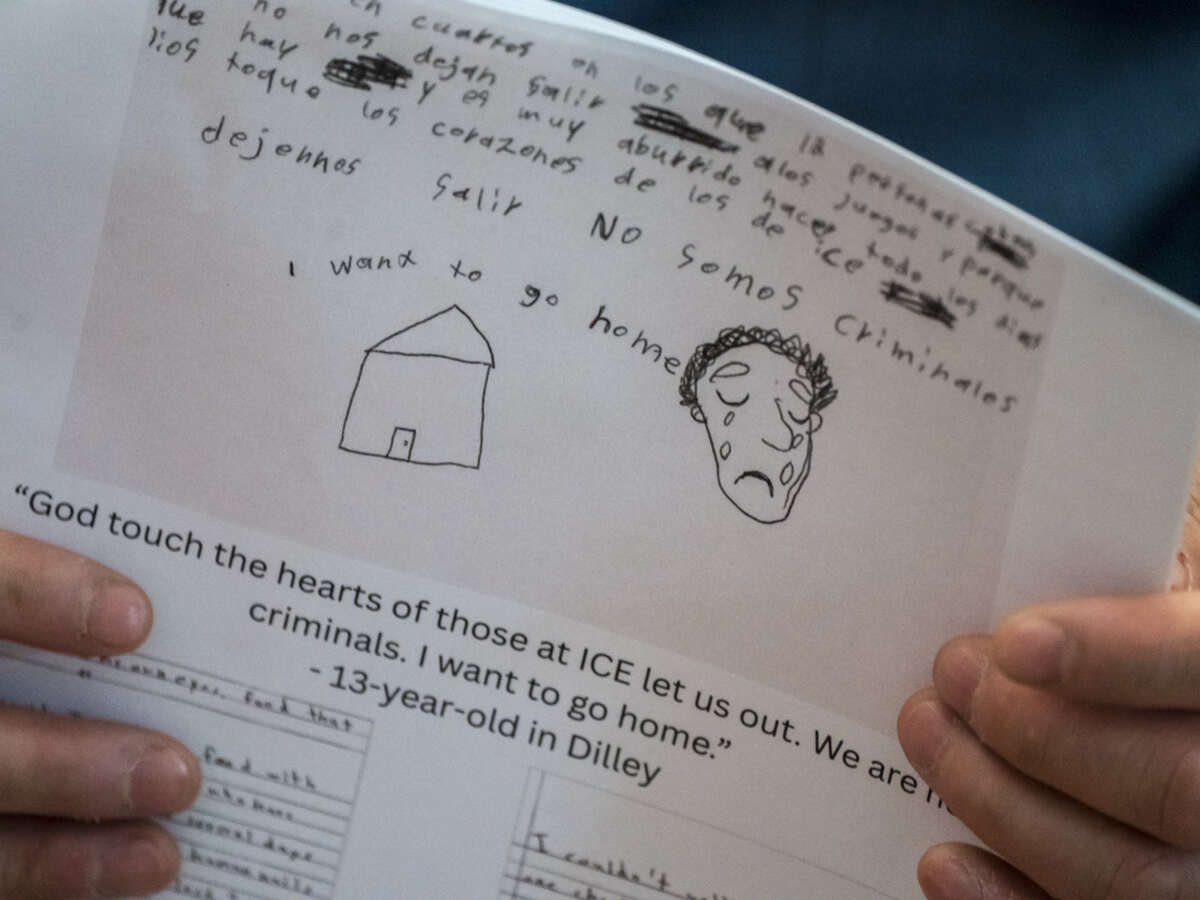
The US’s only detention center for families, which Trump reopened, is routinely holding kids beyond the 20-day limit.
Truthout is an indispensable resource for activists, movement leaders and workers everywhere. Please make this work possible with a quick donation.
Earlier this year, a 16-year-old student at a Los Angeles high school was looking forward to starting his junior year, where he planned to try out for the school’s varsity tennis team. His parents were both college psychology professors.
But in April, U.S. Immigration and Customs Enforcement officers arrested the family, who immigrated from Iran more than a decade ago, after U.S. Secretary of State Marco Rubio told immigration officers to revoke their permanent legal status. ICE separated the family, sending them to two different Texas detention centers.
For the past 123 days, the teen and his mother have lived in an immigrant detention facility in Dilley, where he and other detainees share their rooms with swarms of cockroaches, spiders and mosquitoes, he wrote in a sworn affidavit. Meanwhile, his father is at the South Texas ICE Processing Center in Pearsall.
“We have been put through hell for the past four months, and our physical and mental health have deteriorated in ways that might not be reversible for years,” Maryam Tahmasebi, his mother, wrote in The Nation on Tuesday. “We are only allowed to speak with my husband for 10 minutes every two weeks, under supervision.”
The teen is one of at least 60 children who the Trump administration has held in the Dilley detention center for 100 days or more — far exceeding the 20-day limit for detaining immigrant children — according to a Texas Tribune analysis of federal government data.
On average, children in the Dilley detention center spend 25 days there — but in a six-month period ending in December, that average peaked at 47 days, according to the Tribune’s analysis.
The teen, who is only identified by his initials — S.M.H. — in court documents, said in a sworn declaration that being arrested and detained was “terrifying” and he has lost 10 pounds since his arrest.
His four months of detention is illegal, the family’s lawyers argued in court documents, because it’s six times more than the limit set by a federal court in what’s known as the Flores settlement, a legal agreement from a 1985 class-action lawsuit accusing the federal government of mistreating children in immigration detention.
U.S. District Judge Dolly M. Gee in California, who oversees the Flores settlement, said in a court hearing in June she plans to appoint a monitor to force the Trump administration to comply with the agreement. The case is currently before the 9th Circuit Court of Appeals.
In President Trump’s first term, his administration attempted to end the Flores settlement. Now the administration is trying again to end the agreement, arguing in court that it’s “outdated” and “judicial micromanagement” of its immigration policy.
In a statement to the Tribune, the Department of Homeland Security called the settlement “a tool of the left that is antithetical to the law and wastes valuable U.S. taxpayer funded resources.”
ICE also said in a July court filing that Dilley’s average length of stay was ballooning because of a small number of detainees who are being held longer after being declared national security risks, among other reasons.
In the first year after the March 2025 reopening of the Dilley facility, the country’s only detention center for families, the Trump administration held around 3,000 children for deportation there — more than half of them for more than 20 days.
The Biden administration had ended the practice of detaining families and closed the Dilley facility before the Trump administration reopened it last year as part of its mass deportation efforts.
“The facility is in perpetual violation of the law,” said U.S. Rep. Joaquin Castro, D-San Antonio. Castro, who has made seven oversight visits to the Dilley detention center, has demanded that the Trump administration shut down the facility.
Immigrant children’s rights lawyers have renewed their legal fight against the federal government, claiming the conditions at Dilley and prolonged confinement is evidence the Trump administration is violating the Flores settlement. As part of the ongoing legal dispute, lawyers have collected testimony from families, including children, who describe rotting food, non-potable water and lack of medical attention …