
Crete, Greece — People on the move arriving on Crete are held in makeshift facilities where they have no rights, as authorities freeze asylum registration while implementing the EU’s contested new Migration and Asylum Pact.
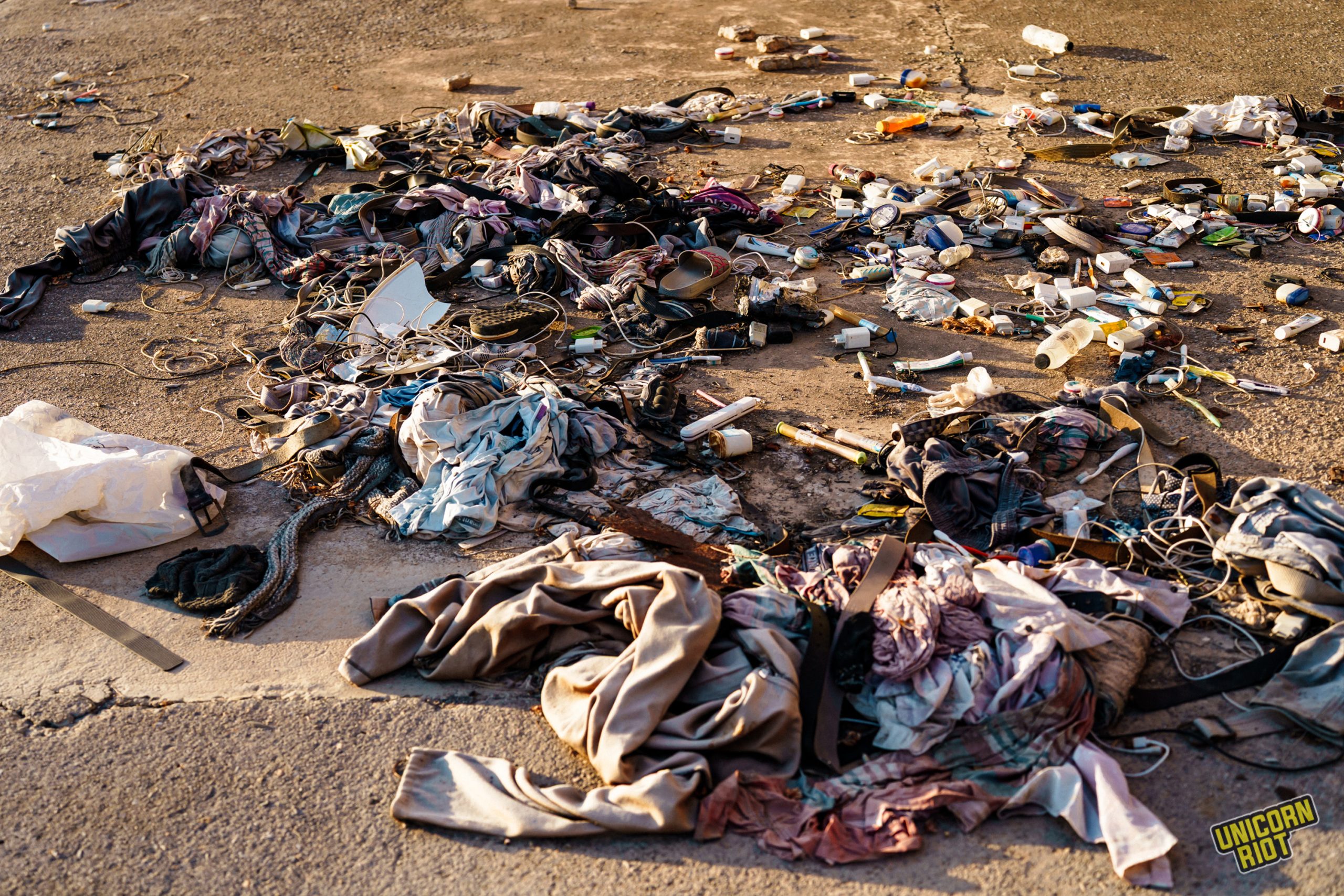
The abandoned Kitrenosis industrial complex sits along the highway connecting the cities of Rethymno and Heraklion, on Crete’s northern coast. The warehouses, disused for years, look out over a cliff that drops straight into the sea. Scattered across the outdoor lot are piles of objects hinting at a transient human presence: faded clothing, broken chargers, crumpled cigarette packs.
Crete has no dedicated reception system, and Kitrenosis is one of the stopgap solutions authorities have turned to after transferring people from the island’s southern shores, where boats arrive, to temporary holding sites in the north.
According to local media reports, the site was last used in December 2025, when it held more than 500 people. It has sat empty since, but inside one of the warehouses, traces of makeshift shelter remain. The space has no windows — a beam of sunlight creeping in through the gap in a broken gate is the only light inside the facility. The floor is littered with the remains of packaged food, half-empty water bottles, gym mats and flattened cardboard boxes.
In November 2025, the Italian organization Operazione Colomba published a report confirming the deplorable conditions at Kitrenosis and the island’s two other temporary facilities: the former exhibition center Agia, located about twenty minutes from downtown Chania, and the old refrigerated storage unit inside the port of Heraklion. The report found that all three sites lacked basic infrastructure and essentials, such as beds, showers, toilets, and clean clothing, and suffered from frequent overcrowding and a lack of privacy.
As of July 2026, all three facilities sit empty, a lull attributed to bad weather slowing arrivals. However, the latest data published by the independent organization Refugee Support Aegean puts the number of people who reached Crete in the first half of the year at roughly 8,500 — a figure confirming that the route from Libya to the island is now well-established, regardless of seasonal fluctuations.
Manufacturing an Emergency
“Crete has been a landing point for a long time. This isn’t new in the past year. What has changed is the political narrative,” Maria, an activist with the Chania-based migrant solidarity collective Steki Metanaston, told Unicorn Riot. As early as 2023, Refugee Support Aegean was already noting a rise in arrivals to Crete, flagging the complete absence of adequate reception infrastructure and procedures. By 2024, the same organization reported a further jump in landings, with more than 5,000 people reaching the island.
It was 2025, however, that saw the sharpest spike in absolute numbers. According to data released by Refugee Support Aegean, more than 20,000 people landed on Crete’s shores that year. This is a significant figure that made the island Greece’s main point of entry, but it needs context. The latest report published by the Asylum Information Database (AIDA), the Greek Council for Refugees and the European Council on Refugees and Exiles (ECRE) confirms that the route has become well-established, while also pointing to an overall drop in arrivals nationwide — down 21% from 2024 to 2025.
That figure has been almost entirely absent from political and media discourse. Instead, the raw number of arrivals hitting Crete’s coastline has been wielded as a propaganda tool by the conservative New Democracy government, first elected in 2019 and now serving its second term.
“The numbers are clear: arrivals are trending downward. What’s changing are the routes,” said Michalis Markodimitrakis, a researcher at the Hellenic Mediterranean University and a member of Thalassa of Solidarity, a Heraklion-based collective. “Greek authorities know this, as this redistribution has been happening for more than two years. But they’ve deliberately chosen to do nothing. Because if you do nothing, you can present the situation as a crisis, and in times of crisis, extreme measures are justified and meet little opposition.”
In July 2025, the Greek Parliament approved a measure suspending asylum claims for three months for people arriving from North African coasts. The decision, criticized by numerous independent organizations, was framed as a direct response to the rise in landings on Crete, which …