
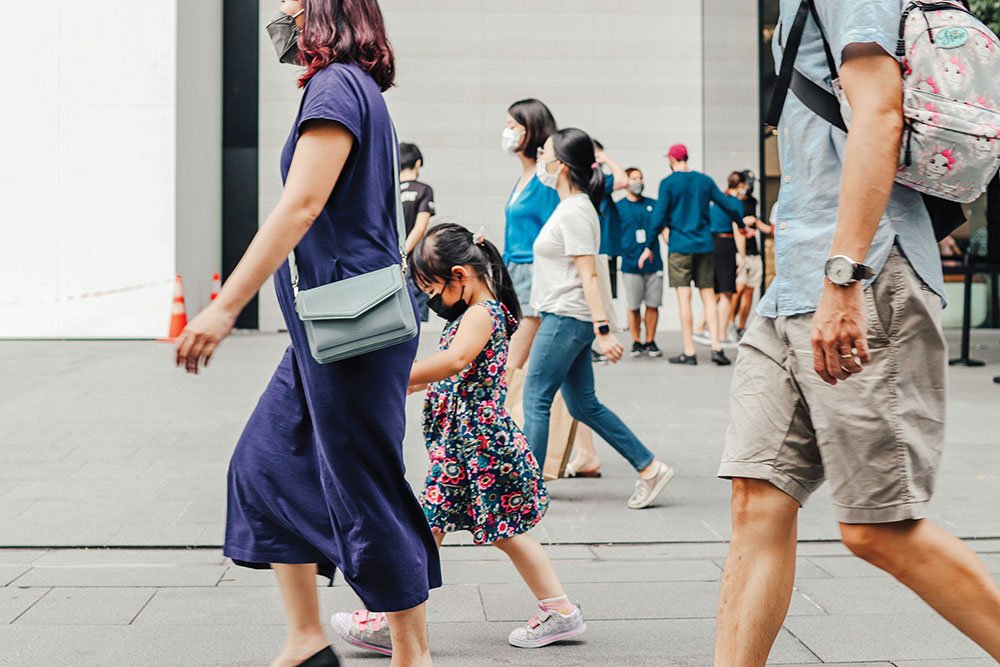
Singapore declares itself a “pro-family” country, but there’s a gap between ideal and reality. Credit: Singapore Stock Photos / Unsplash Unease: Life in Singapore Families Teo You Yenn Ethos Books: 2026 . On the surface, Singapore gleams. It’s wealthy, orderly, safe. The trains (generally) run on time, the amenities are plentiful, and the tiny city-state punches above its weight in international rankings to do with governance and education. Singapore is regularly brought up by policy wonks and politicians around the world—and across the political spectrum—as a model to learn from. The government enthusiastically proclaims itself to be “pro-family”, gearing policies towards supporting (heterosexual) Singaporeans with getting married and having children. What’s not to like?
Everything sounds great on paper. Yet, through years of research and lengthy interviews with close to a hundred parents, sociologist Teo You Yenn uncovers a different reality: “Everyday life is hectic and tense; life is stable but not quite secure; there is a pathway to follow but it does not always seem right; family is everything but family life feels off-kilter.” There is, she observes, a “sense of unease” that sits in the hearts of families in Singapore, regardless of their socioeconomic background.
Teo’s previous book, This Is What Inequality Looks Like—an ethnographic study of low-income households in Singapore—became a national bestseller when it hit the shelves in 2018. It pushed Singaporeans to look beyond rhetoric about “uplifting the poor” and instead consider inequality as a nationwide condition from which none of us can be extricated. With Unease: Life in Singapore Families, Teo directs attention to quotidian family life and once again prompts Singaporeans to reflect on the nature of the water we swim in.
Setting out to understand how parents navigate the much coveted but often elusive work–life balance, Teo finds that it isn’t basic childcare that occupies the most real estate in parents’ minds—it’s education. “Education systems or policies are rarely considered, by scholars or policymakers, as a source of work-life conflict; yet, my research shows that education has become a big component of ‘care labour’,” she writes. “Contemporary demands on parenting go well beyond baths and burps and fevers and sleeplessness, to supervision and nagging and strategising and conflicts of an entirely different, arguably more stress-inducing, level.”
Everyone in Singapore knows of the “kiasu parent”. Translated from Hokkien, to be ‘kiasu’ means to be afraid to lose, or lose out. The kiasu parent is obsessed with ensuring their kid keeps up with, if not outstrips, the rest of their cohort. The kiasu parent studies school rankings as if they contain the meaning of life and plots to get their offspring into the best option. The kiasu parent harasses teachers for progress reports and even demands extra homework. The kiasu parent, keeping tabs on what other (kiasu) parents are doing, signs their sprog up for extra tuition in all subjects… and also for piano, swimming, and ballet.
This archetype of the kiasu parent is often the butt of jokes—a beast to be reckoned with, but one we roll our eyes at. Government officials evoke their spectre when speaking of the need for a “mindset shift”, implying that the problems of a pressure-cooker education system stem from individual attitudes. Things would surely change if only all these parents could just stop being so kiasu.
Teo has no interest in lecturing parents. She’s much more invested in the structures within which Singaporean parents operate. Kiasu parents do not simply emerge, fully-formed, from Singapore’s diminishing rainforests; if they’re terrified of losing out, something must be making them feel like competitors in the first place. And individual parents have neither the clout nor capacity to shape the arena and dictate the rules. That can only come from something bigger and more powerful: government policies, institutional processes and procedures, social conditions that everyone has to respond or adapt to.
Education is a high-stakes game in Singapore. Although there have been shifts, over the years, away from a hyper-focus on academic results, the practices of scoring and sorting are still prevalent. Exam results still determine one’s ability to enter certain schools, access particular opportunities, or obtain qualifications from tertiary institutions—all of which can have a material impact …