
Mankato, MN — Minnesotans gathered on July 25 in the basement of Mankato’s Grace Lutheran Church for a panel on the hyperscale data centers seemingly popping up across the North Star State.
Roughly 80 attendees from the Mankato area and further filled the underground room, frequently adjusting themselves on metal folding chairs throughout the three hour event as the whirring air conditioner kept the space nearly refrigerated.
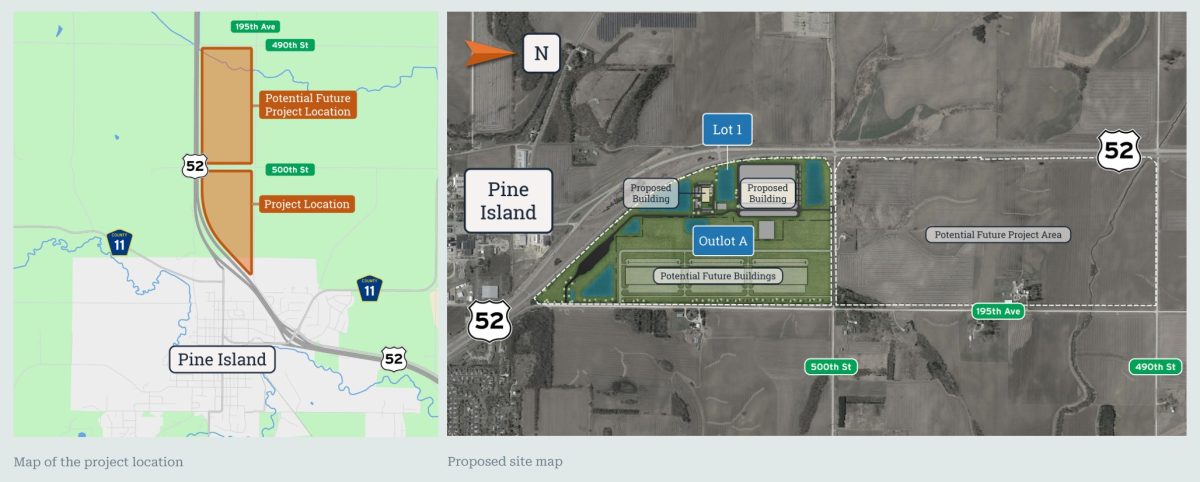
Aubree Derkson of Pine Island, who has been heavily involved in the fight against the planned Google data center in her small, rural community of roughly 3,000, was the event’s first speaker. Pine Island is 20 minutes north of Rochester on U.S. Highway Route 52 in southern Minnesota.
Derkson described the work that goes into investigating data center development, a seemingly monumental task when the local government signs non-disclosure agreements, otherwise known as NDAs, with the companies that own and develop them. As a result of such agreements, she has to use roundabout methods to root out project details, including calling utility companies to ask about
new high voltage power lines
and submitting multiple data requests with different government authorities to build a picture of what’s happening.
“Learn from us,” Derkson said. “Because this is not fun.”
The event, cloistered underground, appeared to drip with a paranoia familiar to conspiracy theorists scanning the horizon for black helicopters through shuttered windows. In this case, however, the conspiracy is not imagined. In both
Pine Island
and
Hermantown
, the projects were kept secret by all parties involved until they were announced in the Star Tribune
following months of lobbying by Google in the state legislature for favorable conditions
before any plans were announced.
Beyond hiding entire projects from the community until they are well underway through NDAs, Google and other companies erecting hyperscale data centers across the state and the rest of the country consistently obfuscate environmental impacts and the real effects these facilities have on communities. Hyperscale sites are massive structures housing thousands of servers for cloud computing and generative AI, exceeding 10,000 square feet.
Underscoring the cloak-and-dagger nature of these developments, each was given a codename in advance of Google claiming ownership: Project Loon in Hermantown and Project Skyway in Pine Island.
Smaller data centers, such as the dozen already spread around the Twin Cities, typically have an energy capacity less than 20 megawatts. Hyperscale data centers planned for the state have capacities well above 100 megawatts, with the largest being 400 megawatts with
the
panned Geronimo Power data center the was planned for Nobles County.
For scale, 100 megawatts is enough electricity for 100,000 households,
according to the International Energy Agency
.
Notably, Google has not yet revealed the expected power consumption of Project Loon or Protect Skyway. However, the plan for Project Loon includes the generation of 700 megawatts, according to a
presentation delivered by Google
in May.
“While data centers are hardly new, hyperscale ones are in a different league,” the Minnesota Center for Environmental Advocacy (MCEA) said in
a June statement regarding a recent court victory against a data center in Faribault
. “They are AI-driven industrial campuses that can consume millions of gallons of water a day for cooling, draw enormous amounts of electricity, generate significant noise and light pollution, and, if enough are built, put serious strain on our state’s already stressed groundwater supply and clean energy goals.”
The opaqueness of these operations when dealing with the public is not due to a lack of knowledge. Rather than figuring such things out on the fly, these things are planned well in advance.
“They know exactly what’s being built,” Bryan Schneider said during his portion of the presentation. Schneider, who was one of the event’s six speakers, has managed data centers in the past and currently works at the Minnesota State University, Mankato, data center.
“They know every floor tile, every ceiling tile, every light that’s going to be in there. […] They know everything. But if you don’t know about it, it’s being withheld.”
Bryan Schneider
Related:
Data Centers, the Climate Crisis, and Community Defense
Project Skyway (Pine Island)
Project Skyway consists of two proposed …