
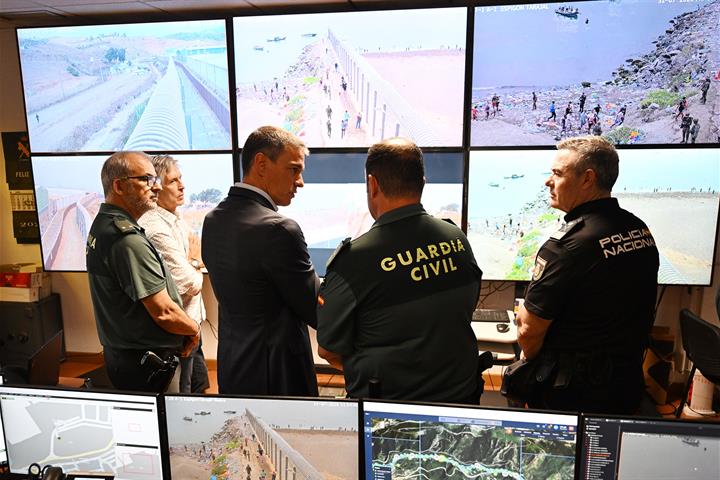
Between 30 and 31 July, an extraordinary movement of people crossed from Morocco into Ceuta, the Spanish-controlled enclave in North Africa claimed by Morocco. Spain’s Interior Ministry estimated that approximately 50,000 people —most of them young Moroccans—entered by land or sea, while Ceuta’s authorities placed the number closer to 60,000. The Spanish government deployed soldiers and additional police as the existing border and reception systems collapsed.
The death toll remains disputed. Spanish authorities initially reported recovering 57 bodies, then 67, while the Moroccan Association for Human Rights estimated nearly 130 victims.
Spain’s prime minister Pedro Sánchez attributed the mobilisation principally to misleading social-media posts about a Spanish Supreme Court judgement issued on 8 July. The judgement held that the special border-rejection procedure applying in Ceuta and Melilla could not be used to return people intercepted at sea without an individual legal process. It did not grant migrants a right to remain in Spain, nor did it prevent eventual deportation.
Moroccan human-rights activists confirmed that social-media claims that “the border was open” contributed to the movement. Moroccan security forces were reported to stand aside initially , later to use batons, tear gas, water cannon and warning shots against people attempting to cross.
By Friday evening, Spanish authorities said that more than 48,000 people had returned to Morocco . The military deployment formed part of the context, but many reportedly returned because they were exhausted, hungry and stranded in Ceuta without a realistic route to mainland Spain.
Fortress Europe’s deadly borders
Mainstream accounts have placed the incident within the context of smuggling and interstate rivalries. In 2022, Sánchez’s government endorsed Morocco’s claim to Western Sahara, a year after Trump’s administration had done so in exchange for Morocco normalising relations with Israel. Spain has also recently pursued energy and trade agreements with Algeria, one of Morocco’s regional rivals.
Meanwhile, Spain’s relations with the United States and Israel have reportedly been strained by the Sánchez government’s opposition to the war against Iran and the genocide in Gaza . This has fuelled allegations that Israeli intelligence services helped mobilise the migrants. The Spanish government has also been attacked for its supposedly “soft” migration policy, particularly its decision to regularise approximately half a million migrant workers —most of them Latin American and many of whom originally arrived in Europe by air.
These explanations, however, obscure the deeper structure of the European border regime. For at least three decades , the EU and its member states have externalised migration control by financing, equipping and politically supporting non-European governments to stop people before they reach European territory. Morocco is one of the principal states incorporated into this system. In practice, authoritarian governments on Europe’s southern frontier are paid to act as guards for Fortress Europe.
The EU is Morocco’s largest trading partner and foreign investor. Morocco has become an important manufacturing and outsourcing base for automotive , aerospace, logistics, technology, renewable-energy and agribusiness supply chains. Comparatively inexpensive labour is a decisive factor among others for Morocco’s “green industrialisation” that reproduces colonial patterns.
Spain and Morocco are also jointly organising the 2030 World Cup, a project unfolding alongside successive waves of repression against workers’ struggles in both countries. During Morocco’s 2025 youth protests—whose slogans included “We want hospitals, not stadiums”—security forces killed three people and injured dozens.
In this context, calls to support Sánchez’s Spain against migrants—or to side with it in its rivalries with the United States and Israel—ultimately demand that Europe’s multinational working class submit to the continent’s defence and security apparatus and to the ReArm Europe programme.
The Mediterranean remains the world’s deadliest migration route, with thousands dying every year while attempting to reach safety. Many of these deaths are never documented. While states respond with violent pushbacks , these waves of migration will continue , driven by the global surplus proletariat’s pursuit of freedom, security and a more dignified life—a structural …