
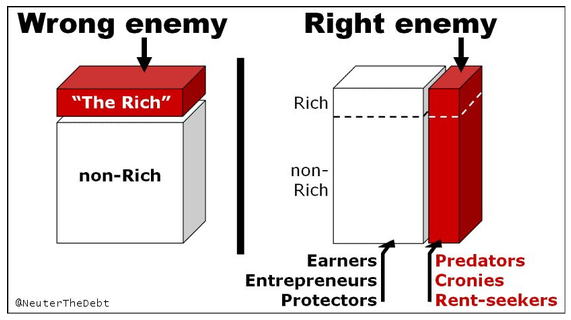
…A Guide For Right-Wing Polemicists and Other Sycophants
In recent months the public outcry against concentrated wealth and inequality, and the growing influence of progressives and democratic socialists with anti-billionaire rhetoric on Democratic politics, has evoked a corresponding alarm from the center, center-right, and right. The counter-cry in defense of billionaires has come from organized billionaire-funded efforts like the March for Billionaires, bedbugs at the
NYT
Opinion Page and
The Atlantic
, perennial havers of hot-takes like Matt Yglesias, concern trolling career consultants like James Carville, and center-right Democratic politicians like Tom Suozzi at Promise to America.
In substance, it’s little more than a warmed-over version of rhetoric from Romney’s 2012 campaign and the abortive primary efforts of Michael Bloomberg and Howard Schultz. Even so, it’s generated a great deal of content, which has been promoted in a wide variety of prominent venues.
Since this seems to be go-time for defending billionaires, you might as well jump on the bandwagon, too. I can’t guarantee you’ll get picked up by The Atlantic and appear alongside the Jonathans Rauch, Chait, and Haidt, or Ross Douthat — but it’s worth a shot. That’s why I’ve gone through an enormous body of hand-wringing literature by some of the most irritating people alive, scanned it for the points they share in common, and compiled this list of helpful hints for would-be bootlickers.
1) Say They “Create Value.”
This defense takes the form, variously, of arguments that billionaires’ companies create things that people desire, that their investments facilitate such innovation or create jobs, that their capital is necessary for production to take place, etc.
As the March for Billionaires Bluesky account baldly
states
: “Billionaires get a bad rap. But most of them make our lives much better.”
The March for Billionaires
website
argues, at greater length, that most billionaires “made their fortunes building companies that employ thousands and solve real problems…. These billionaires didn’t steal from you. They created new products, new services, new possibilities that millions of people freely chose.” Let’s take a look at their list of examples:
Jeff Bezos. Built a store where you can get nearly anything delivered to your doorstep, tomorrow.
Brian Chesky.
Created Airbnb, connecting travelers to homeowners with spare rooms.
Taylor Swift.
Sold 100 million albums and filled stadiums around the world.
Larry Page & Sergey Brin.
Made the world’s information accessible to everyone, for free.
Dustin Moskovitz.
Co-founded Facebook, then dedicated billions to saving lives through effective philanthropy.
Noubar Afeyan.
Incubated Moderna and dozens more biotech companies.
Hamdi Ulukaya.
Popularized Greek yogurt with Chobani.
I won’t comment on Ulukaya, because he seems relatively minor as billionaires go, and I don’t know anything about the back-story of him or Chobani.
But every one of the other examples involves some form of platform capitalism or other industry in which state-enforced entry barriers like intellectual property, or state subsidies, are central to their profit model. In every case, they extract wealth not by actually making or doing anything, but by controlling access to the conditions under which other people are allowed to make and do things. Even Taylor Swift’s music industry, while it does indeed produce music, relies heavily not only on draconian copyright laws but on technical regulations which deliberately break hardware to impede even what’s legally considered fair use. The drug industry, of which Moderna is part, is notorious for its reliance on patent law, and reimportation barriers, to facilitate monopoly prices ten, twenty or more times production cost. Facebook, Amazon, Google, and Airbnb are all Death Star platforms whose monopoly power depends on both intellectual property and laws against “criminal disregard of business model,” which prohibit what Cory Doctorow calls “
adversarial
interoperability
.” Ironically, Facebook got its start through adversarial interoperability, providing a mechanism by which to import all one’s contacts and transfer notifications from MySpace to Facebook without permission; then Mark Zuckerberg turned around and lobbied to outlaw the practice in future. Were this avenue of competition still legal, new platforms could overcome network effects by doing to …